
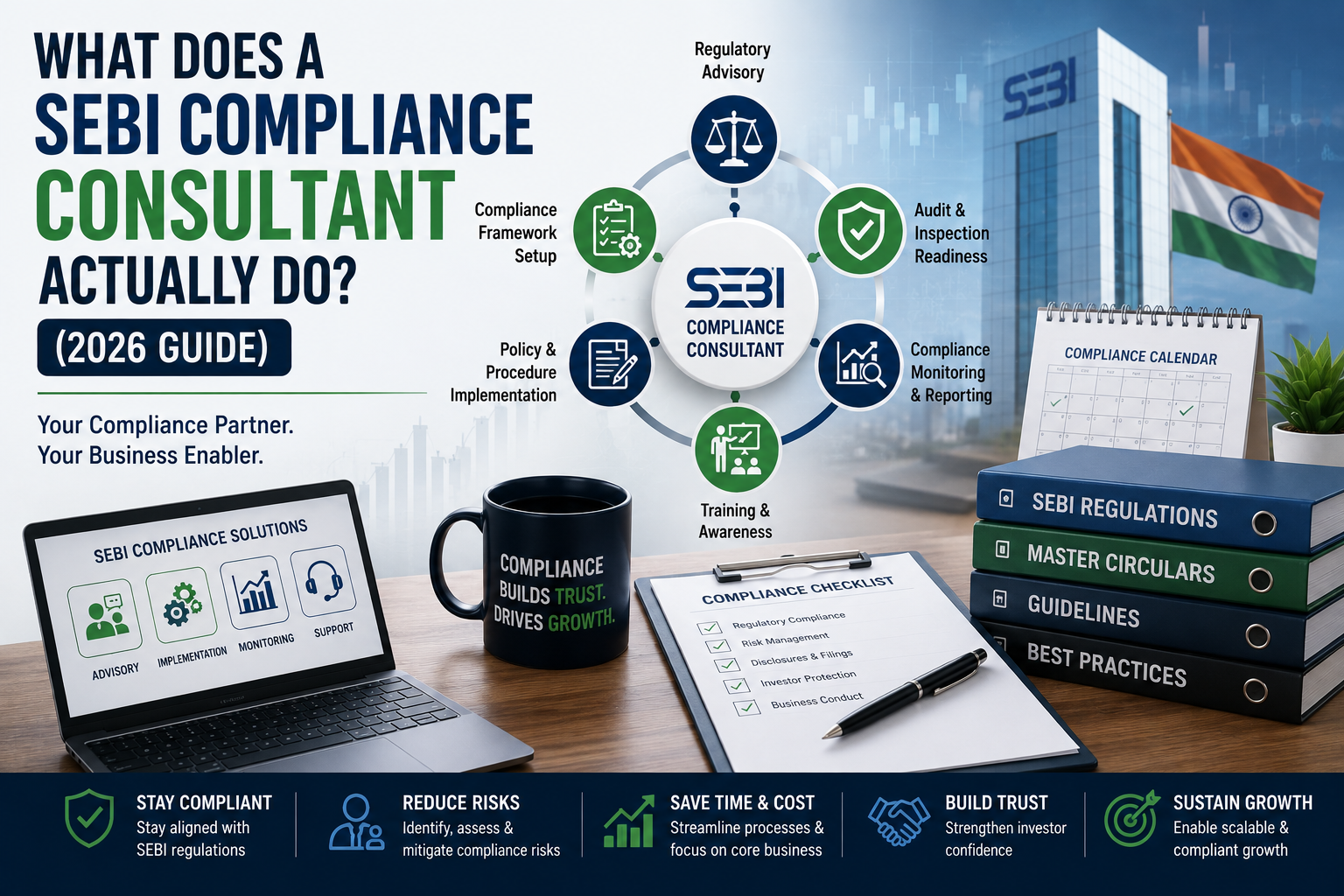
For many entrepreneurs entering India's securities market, obtaining a SEBI registration often appears to be the final milestone before commencing operations. In reality, registration marks only the beginning of an ongoing compliance journey. Every SEBI-regulated entity must continuously comply with evolving regulations, maintain prescribed records, submit periodic disclosures, implement internal controls, respond to regulatory changes, and prepare for inspections and audits.
Whether you operate as a Research Analyst (RA), Investment Adviser (IA), Portfolio Manager (PMS), Alternative Investment Fund (AIF), Stock Broker, Investment Banking professional, or another SEBI-regulated intermediary, regulatory compliance is an integral part of day-to-day business operations.
This is where a SEBI Compliance Consultant becomes valuable. Rather than assisting only with registration, a compliance consultant works alongside regulated entities to build, implement, monitor, and improve compliance systems throughout the life of the business.
Understanding the role of a SEBI Compliance Consultant can help firms appreciate why proactive compliance is often more effective—and considerably less expensive—than dealing with regulatory issues after they arise.
Who is a SEBI Compliance Consultant?
A SEBI Compliance Consultant is a professional or advisory firm that specialises in helping businesses comply with the regulatory framework administered by the Securities and Exchange Board of India (SEBI).
Unlike general business consultants, a compliance consultant focuses specifically on regulatory obligations applicable to financial market intermediaries. Their work combines legal interpretation, governance advisory, documentation, compliance monitoring, policy development, regulatory reporting, audit support, and practical implementation of compliance frameworks.
An effective consultant not only understands the applicable regulations but also helps businesses translate legal requirements into workable operational processes.
For many firms, the compliance consultant functions as an external regulatory partner, supporting management in maintaining a strong culture of compliance.
Why Businesses Need a Compliance Consultant
SEBI regulations are regularly amended to address new market developments, emerging technologies, investor protection concerns, and evolving governance expectations. Keeping track of these changes while simultaneously managing day-to-day business operations can be challenging, particularly for small and medium-sized firms.
A compliance consultant helps organisations stay informed about regulatory developments and understand how those changes affect their operations. Instead of reacting to regulatory issues after receiving notices or inspection observations, businesses can proactively identify compliance gaps and implement corrective measures.
This approach reduces regulatory risk, strengthens governance, and allows management to focus on business growth with greater confidence.
Registration and Licensing Support
One of the most visible responsibilities of a SEBI Compliance Consultant is assisting clients with obtaining regulatory registrations.
This may involve advising on eligibility requirements, preparing application documents, drafting declarations, reviewing organisational structures, coordinating with professionals, responding to regulatory queries, and guiding applicants through the registration process.
However, registration support represents only a small portion of the consultant's overall role. Long-term compliance after registration is generally far more significant than the initial licensing process.
Designing a Compliance Framework
Every regulated entity should operate within a structured compliance framework rather than relying on ad hoc processes.
A compliance consultant assists organisations in developing internal systems that define regulatory responsibilities, reporting mechanisms, documentation standards, approval workflows, conflict management procedures, and governance controls.
A well-designed compliance framework helps ensure that regulatory obligations are addressed consistently across the organisation rather than depending on individual employees.
Strong governance also improves operational efficiency and reduces the likelihood of compliance failures.
Ongoing Compliance Monitoring
Compliance is not a once-a-year activity.
Research Analysts, Investment Advisers, Portfolio Managers, and other intermediaries are required to fulfil continuing obligations throughout the year. These may include maintaining statutory records, monitoring regulatory changes, making periodic disclosures, updating internal policies, reviewing advertisements, handling investor grievances, and ensuring that business practices remain compliant.
A SEBI Compliance Consultant helps organisations establish systems for monitoring these ongoing obligations, reducing the risk of missed deadlines or procedural deficiencies.
Many firms engage consultants through monthly or annual compliance retainership arrangements to receive continuous regulatory support.
Annual Compliance Audits
Several categories of SEBI-registered intermediaries are required to undergo periodic compliance audits under the applicable regulatory framework.
A compliance consultant plays an important role in preparing organisations for these audits by reviewing records, identifying deficiencies, coordinating with auditors, assisting in rectification of observations, and ensuring that audit documentation is complete and organised.
Preparation before the audit often leads to a smoother audit process and helps minimise avoidable observations.
Regulatory Documentation
Documentation forms the backbone of regulatory compliance.
SEBI-regulated entities are expected to maintain various policies, registers, declarations, client records, agreements, disclosures, internal procedures, and governance documents.
A compliance consultant assists in preparing and periodically updating these documents to ensure that they remain consistent with regulatory developments and business operations.
Well-maintained documentation also demonstrates organisational preparedness during inspections and compliance reviews.
Website Compliance and Digital Governance
In today's digital environment, a firm's website is often the first point of interaction with prospective investors.
SEBI regulations increasingly emphasise transparency, investor disclosures, mandatory website information, grievance redressal mechanisms, advertisement compliance, and accessibility requirements. Additionally, organisations should consider obligations arising under the Digital
Personal Data Protection (DPDP) Act, 2023 and broader cybersecurity expectations.
A SEBI Compliance Consultant reviews digital platforms to identify regulatory gaps and recommend improvements that strengthen both compliance and investor confidence.
Website compliance has become an increasingly important area of advisory services as regulatory expectations continue to evolve.
Advertisement and Marketing Compliance
Marketing within the financial services sector is subject to regulatory oversight.
Advertisements, social media content, webinars, promotional campaigns, videos, websites, and investor communications should comply with applicable SEBI advertisement requirements and avoid misleading claims, exaggerated performance statements, or prohibited representations.
A compliance consultant reviews promotional material before publication to minimise regulatory exposure while enabling organisations to communicate effectively with prospective clients.
This proactive review process helps prevent compliance issues that may otherwise arise from marketing activities.
Inspection Readiness
SEBI inspections can examine multiple aspects of an organisation's compliance framework, including governance, documentation, record maintenance, client communications, disclosures, internal controls, and operational practices.
Rather than waiting for an inspection notice, many organisations conduct periodic internal reviews to assess their level of preparedness.
A compliance consultant helps identify potential weaknesses, recommend corrective actions, organise records, and strengthen compliance systems before regulatory inspections occur.
Being inspection-ready reduces stress and demonstrates a mature compliance culture.
Training and Compliance Awareness
Compliance depends not only on written policies but also on employee understanding.
A compliance consultant may conduct training sessions for directors, compliance officers, research teams, advisory personnel, operations staff, and senior management on regulatory developments, ethical obligations, conflict management, cybersecurity awareness, and governance practices.
Regular training encourages consistent compliance across the organisation and reduces operational risk arising from human error.
Strategic Regulatory Advisory
Beyond routine compliance, organisations frequently require guidance when introducing new products, expanding operations, adopting new technologies, restructuring business models, or responding to regulatory changes.
A compliance consultant provides practical advice on how these developments interact with applicable regulations, enabling businesses to make informed decisions while maintaining compliance.
This strategic role becomes increasingly valuable as financial regulation grows more complex.
Choosing the Right SEBI Compliance Consultant
Selecting a compliance consultant should involve more than comparing professional fees.
Businesses should consider the consultant's regulatory expertise, experience with relevant SEBI intermediaries, understanding of practical implementation challenges, multidisciplinary capabilities, responsiveness, and ability to provide ongoing support rather than only transactional services.
A consultant who combines legal knowledge with operational experience can often provide more practical and sustainable compliance solutions.
Long-term regulatory partnerships generally deliver greater value than engaging different advisors for isolated assignments.
How KP RegTech Supports SEBI-Regulated Entities
KP RegTech exclusively focuses on regulatory compliance for Research Analysts, Investment Advisers, Portfolio Managers, and other SEBI-regulated entities. Our services extend beyond registration assistance to include annual compliance audits, ongoing compliance retainership, compliance framework development, inspection readiness, website compliance, advertisement review, secretarial support, regulatory documentation, DPDP compliance advisory, and digital governance solutions.
By combining the expertise of Company Secretaries, Chartered Accountants, Advocates, and technology professionals, we help businesses establish practical compliance systems that support sustainable growth while reducing regulatory risk.
Frequently Asked Questions
Is a SEBI Compliance Consultant required after registration?
While not always mandatory, engaging a compliance consultant can help organisations manage ongoing regulatory obligations, monitor compliance, and reduce the risk of non-compliance.
Can a compliance consultant assist with SEBI inspections?
Yes. Consultants commonly assist with inspection readiness, documentation reviews, compliance gap assessments, and coordination during regulatory inspections.
Does a compliance consultant provide only registration services?
No. Registration support is only one aspect of the role. Most consultants also assist with compliance monitoring, audits, documentation, governance, website compliance, regulatory updates, and ongoing advisory.
Can startups benefit from engaging a compliance consultant?
Yes. Early-stage compliance frameworks often prevent operational issues and reduce regulatory risks as the business grows.
How often should compliance systems be reviewed?
Compliance frameworks should be reviewed periodically, particularly after regulatory amendments, organisational restructuring, technology changes, or observations arising from audits or inspections.
Conclusion
A SEBI Compliance Consultant does far more than assist with registration or regulatory paperwork. Their role is to help regulated entities build robust compliance systems, interpret evolving regulations, strengthen governance, prepare for audits and inspections, and maintain continuous compliance throughout the business lifecycle. For Research Analysts, Investment Advisers, Portfolio
Managers, and other SEBI-regulated intermediaries, engaging an experienced compliance consultant is not merely a regulatory safeguard—it is a strategic investment in operational resilience, investor confidence, and long-term business success.