
About the author: This guide is prepared by the compliance team at KP Regtech — a specialist SEBI regulatory advisory firm helping Investment Advisers, Research Analysts, and fintech businesses with registration, audits, and ongoing compliance.
If you are a SEBI-registered Investment Adviser or Research Analyst searching for compliance software, you are probably asking two questions at the same time. The first is: how much does it cost? The second, which most articles do not answer honestly, is: will software alone actually keep me compliant?
This guide answers both. It explains what SEBI compliance software typically costs in India in 2026, what these tools can and cannot do for an IA or RA, and why many registered intermediaries find that software alone does not replace the specialist advisory and audit support that SEBI's current regulatory framework requires.
What Is SEBI Compliance Software?
SEBI compliance software refers to digital tools designed to help regulated entities manage their compliance obligations — tracking deadlines, storing documents, generating reports, and sending reminders for regulatory filings. In the Indian market, these tools range from generic compliance management platforms used across industries to SEBI-specific tools marketed to investment intermediaries.
It is important to distinguish between two categories before evaluating pricing:
Generic compliance management software covers broad statutory obligations — labour law filings, GST, environmental compliance, and so on. Some of these platforms include a SEBI module as part of a wider compliance suite. They are typically priced for mid-to-large corporates and are not designed around the specific obligations of an individual IA or RA.
SEBI-specific compliance tools — such as portfolio management software with built-in compliance modules, RA practice management platforms, or SCORES grievance tracking integrations — are more directly relevant to registered intermediaries but are still a developing category in India. As of 2026, there is no dominant, widely adopted SEBI-specific compliance software platform for individual IAs and RAs comparable to what exists for, say, mutual fund distributors.
SEBI Compliance Software Pricing in India (2026)
Pricing for compliance software used by SEBI-regulated entities in India varies significantly depending on the type of tool, the entity's size, and the features included.
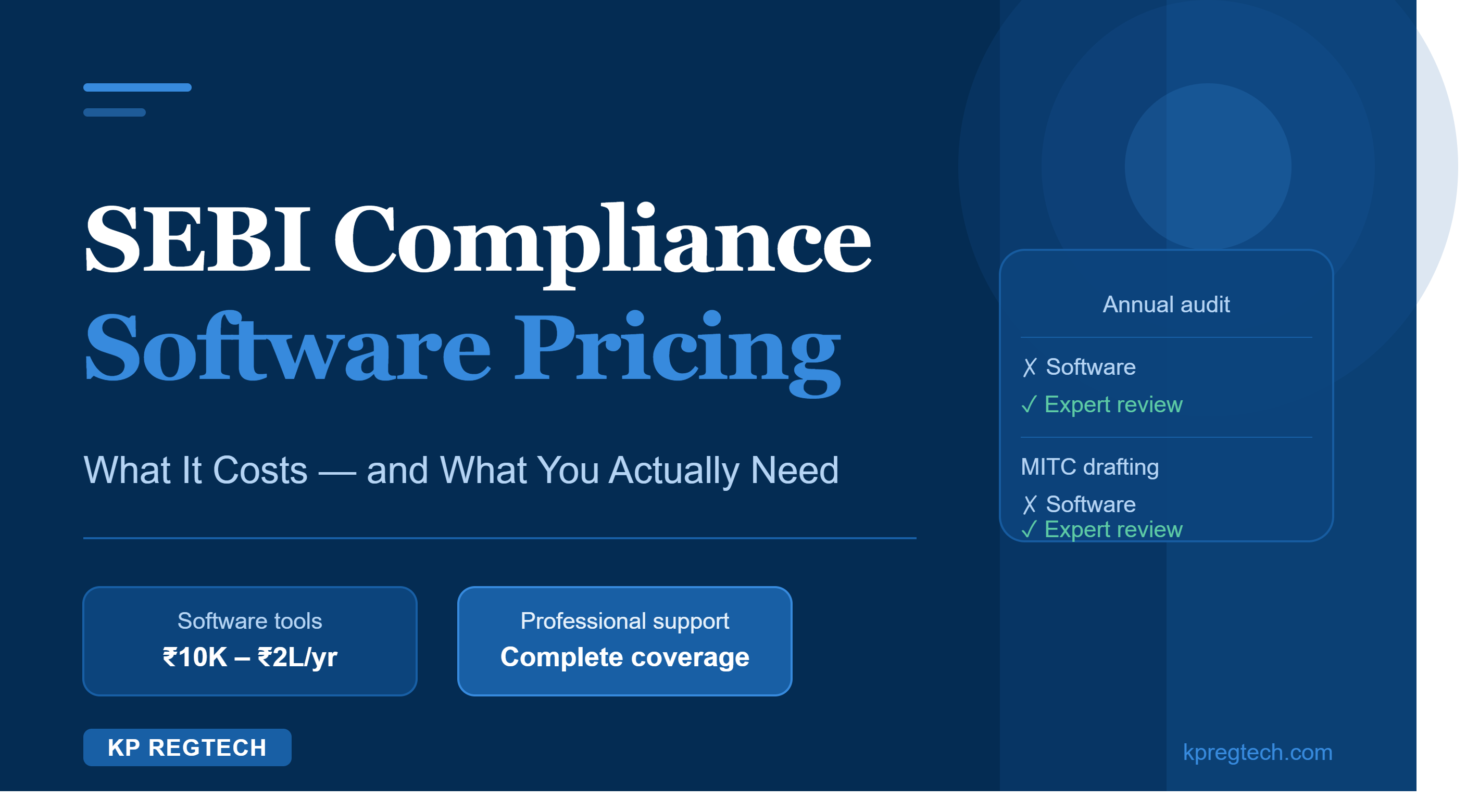
Generic compliance management platforms (enterprise tier) Tools like those offered by major statutory compliance platforms in India typically start at ₹50,000–₹2,00,000 per year for a single-entity licence, with pricing scaling based on the number of users, compliance tasks tracked, and integration requirements. These are generally designed for companies with dedicated compliance teams and multiple regulatory frameworks to manage simultaneously — not for individual IAs or small RA firms.
SEBI-focused practice management tools Some fintech platforms offer SEBI-oriented compliance modules — SCORES integration, filing reminders, document storage, and client KYC management. Pricing for these typically ranges from ₹10,000–₹60,000 per year depending on features. However, these tools are largely deadline trackers and document repositories. They do not conduct compliance audits, draft policies, review research reports for regulatory compliance, or advise on SEBI circular updates.
Custom compliance workflow tools Some larger RA and IA firms build custom internal compliance tracking using project management tools, CRMs, or workflow platforms. The cost of this approach varies widely depending on the complexity of customisation — from ₹0 for a self-managed spreadsheet system to several lakhs for a custom-built platform.
What affects pricing:
• Number of users or clients tracked
• Integration with SCORES, IAASB, or RAASB portals
• Document management and version control features
• Automated regulatory update alerts
• Audit trail and reporting capabilities
• Level of SEBI-specific versus generic compliance coverage
What SEBI Compliance Software Can Do
Used correctly, a compliance software tool can add genuine value for an IA or RA by:
Tracking deadlines. The annual IA and RA compliance calendar has specific deadlines — April 30 for deposit updates, September 30 for audit completion, October 31 for corrective action report submission. A compliance calendar tool that sends automated reminders before each deadline reduces the risk of a missed filing.
Organising client documentation. KYC records, MITC consent documents, signed advisory agreements, and client communication records must be maintained for a minimum of five years under the IA and RA Regulations. A structured document management system makes audit preparation significantly faster.
Storing research documentation. For Research Analysts, every recommendation must have a documented basis — working papers, financial models, chart analysis, and rationale. Software that organises these records by client, date, and security makes it easier to demonstrate compliance during an inspection.
Managing grievance records. SCORES 2.0 complaints and grievance records must be tracked and responded to within prescribed timelines. A tool that centralises this tracking reduces the risk of a complaint going unanswered within the regulatory timeframe.
Generating compliance reports. Some platforms can generate templated compliance status reports — useful for internal review and pre-audit preparation.
What SEBI Compliance Software Cannot Do
This is where honest evaluation matters. For a SEBI-registered IA or RA, compliance is not primarily a data management problem. It is a regulatory interpretation and implementation problem — and software does not solve this.
Software cannot conduct your annual compliance audit. Under Regulation 19(3) of the IA Regulations and Regulation 25(3) of the RA Regulations, the annual audit must be conducted by a qualified professional — a Company Secretary, Chartered Accountant, or Cost and Management Accountant. A software platform cannot replace this requirement. It can organise your records for the audit, but it cannot conduct the audit itself, identify regulatory gaps, or produce the audit report that must be submitted to IAASB or RAASB.
Software cannot tell you whether your MITC is correctly drafted. The Most Important Terms and Conditions — mandatory from February 17, 2025 — must be standardised in accordance with the format established by the Industry Standards Forum in consultation with IAASB/RAASB and SEBI. Whether your MITC meets this standard requires expert review, not a template populated through software.
Software cannot review your research reports for regulatory compliance. Research reports must include specific analyst disclosures, conflict-of-interest declarations, methodology statements, and appropriate disclaimers. Whether a report meets these requirements requires judgment — regulatory knowledge applied to specific content. Software cannot do this.
Software cannot update your compliance framework after a SEBI circular. When SEBI issues a new circular — as it did in December 2024, January 2025, June 2025, and August 2025 — your policies, MITC, Investor Charter, and client agreements may need to be updated. Identifying what needs to change and how to change it requires specialist regulatory knowledge. Software can send you an alert that a circular was issued. It cannot tell you what it means for your practice.
Software cannot prepare you for a SEBI inspection. An inspection involves a SEBI official reviewing your records, asking questions about your practice, and evaluating whether your documentation reflects how you actually operate. Preparation for this requires a human review of your actual records — not a dashboard that says your documents are filed.
Software cannot advise you when you receive a SEBI notice. If you receive a query, a show-cause notice, or an inspection letter, you need a qualified person to help you respond. Software has no role in this process.
The Real Cost Comparison: Software vs. Professional Compliance Support
For most individual IAs and small RA firms, the relevant comparison is not between different software platforms. It is between investing in compliance software and investing in professional compliance support. Both options cover the basics. Compliance software can track your annual deadlines and store your documents. Professional compliance support does the same — and everything beyond that.
The gap becomes significant the moment your compliance obligations move beyond calendar reminders and file storage. Compliance software cannot conduct your annual compliance audit under Regulation 19(3) or Regulation 25(3) — that requires a qualified professional. It cannot review or draft your MITC to confirm it meets the current IAASB and RAASB standards. It cannot review your research reports for regulatory compliance, assess your website against SEBI's current disclosure requirements, or audit your advertisements and social media content for prohibited claims. When a SEBI circular is issued, software can send you a notification — but it cannot tell you what the circular means for your practice, which documents need updating, and what needs to change before your next audit. And when a SEBI inspection notice or show-cause notice arrives, software has no role in the response at all.
For a SEBI-registered IA or RA whose compliance obligations are primarily regulatory — audits, policy drafting, disclosure reviews, circular implementation, and inspection readiness — professional compliance support addresses needs that software simply cannot.
The cost picture is also worth understanding clearly. The annual compliance audit alone, when engaged separately from an ongoing support arrangement, typically costs between ₹15,000 and ₹50,000 for individual IAs and RAs depending on firm size, audit scope, and the consultant engaged. When you add a software subscription on top of that for deadline tracking and document storage, the combined spend often exceeds what a year-round professional compliance engagement costs. KP Regtech's Compliance-as-a-Service model bundles the annual audit with continuous compliance management — covering every obligation that software cannot — at a total cost that is typically comparable to or below that combined figure, while leaving no compliance gap unaddressed..
When Does Compliance Software Make Sense?
Software is a useful complement — not a substitute — for professional compliance support in specific situations:
Large RA or IA firms with multiple analysts or advisers who need a centralised system for tracking individual analyst certifications, client assignments, and documentation across a team benefit from a structured software solution alongside compliance advisory support.
Firms that have strong in-house compliance knowledge but need a system to organise, track, and report on compliance activities can use software as an efficiency tool — provided the substantive compliance work is being done by qualified people.
Pre-audit documentation preparation — organising client files, research records, and policy documents in a structured, searchable system before an audit — is a genuine use case where software adds value.
For individual IAs and RAs, or small firms without a dedicated in-house compliance function, the most common outcome of investing in compliance software without professional support is a well-organised set of documents that are themselves non-compliant — because the software organised what existed without identifying what was missing or incorrect.
How KP Regtech Supports IAs and RAs Without Software Dependency
At KP Regtech, we provide the compliance functions that software cannot replace — and we manage the compliance calendar that software can track, so you do not need to invest in both separately.
Our Compliance-as-a-Service model for Investment Advisers and Research Analysts includes:
Annual compliance audit under Regulation 19(3) / Regulation 25(3), using a fully updated 2025–2026 audit framework that covers MITC compliance, AI disclosure, deposit maintenance, website compliance, research documentation, and model portfolio obligations where applicable.
Year-round compliance calendar management — covering every deadline in the IA and RA annual calendar, with advance notice and implementation support for each obligation.
Regulatory circular monitoring and implementation — every SEBI circular, FAQ, and master circular update reviewed and translated into specific actions for your practice.
MITC and advisory agreement review — ensuring your client documentation meets the current IAASB and RAASB standards, not a template from two years ago.
Website compliance review, advertisement and content audits, and inspection readiness preparation.
Contact KP Regtech to discuss compliance support for your IA or RA practice →
Frequently Asked Questions
- How much does SEBI compliance software cost in India in 2026?
- Can compliance software replace the annual compliance audit for IAs and RAs?
- What can SEBI compliance software genuinely help with?
- Is compliance software sufficient for a SEBI-registered IA or RA?
- What is Compliance-as-a-Service and how does it differ from compliance software?
- What should I look for if I do want to invest in compliance software?
Disclaimer: This article is for informational purposes only and does not constitute legal or regulatory advice. Investment Advisers and Research Analysts should consult a qualified compliance professional for guidance specific to their registration category and obligations.