
About the author: This guide is prepared by the compliance team at KP Regtech — a specialist SEBI regulatory advisory firm helping Research Analysts, Investment Advisers, and finfluencers with SEBI registration, NISM certification planning, and ongoing compliance.
If you are planning to register with SEBI as a Research Analyst or Investment Adviser, the first practical question most people ask is: which NISM certification do I need, and how do I get it?
The answer depends entirely on which SEBI registration you are applying for. The certifications required for a Research Analyst are completely different from those required for an Investment Adviser. Getting this wrong — appearing for the wrong exam, or applying for SEBI registration without the correct certification — delays the entire registration process and creates unnecessary costs.
This guide covers every NISM certification currently required for SEBI RA and IA registration in 2026, the exam details, fees, validity periods, and what happens after you pass.
Why NISM Certification Is Mandatory — Not Optional
The legal basis for mandatory NISM certification is the SEBI (Certification of Associated Persons in the Securities Markets) Regulations, 2007, known as the CAPSM Regulations. Under these regulations, SEBI has designated NISM — the National Institute of Securities Markets, established by SEBI in 2006 — as the body responsible for administering mandatory certification examinations for associated persons in the securities market.
The practical effect is this: without the correct NISM certification, SEBI will not process your registration application. You do not get to skip the certification based on your qualifications, work experience, or expertise. The certification is a precondition for registration, not a post-registration requirement.
NISM certifications carry regulatory weight — they are not professional development qualifications or resume badges. When SEBI's regulations specify that a Research Analyst must hold the NISM Series-XV certification, an uncertified person cannot legally register as one, regardless of their academic background.
NISM Certifications Required for Research Analyst Registration
NISM Series-XV: Research Analyst Certification Examination
This is the primary mandatory certification for SEBI Research Analyst registration under Regulation 7(2) of the SEBI (Research Analysts) Regulations, 2014.
The NISM Series-XV certification is required for individual Research Analysts applying for SEBI registration, the Principal Officer of a non-individual research entity, and all employees and partners of a registered RA firm who are engaged in the preparation or publication of research reports or research analysis.
Important 2026 update: NISM launched a revised version of the NISM Series-XV examination with effect from January 20, 2026. The revised exam reflects changes introduced by the December 2024 RA Regulation amendments and the January 2025 SEBI Guidelines — including updated syllabus coverage on MITC obligations, model portfolio frameworks, AI tool usage standards, and the RAASB supervisory framework. If you are preparing for the exam in 2026, ensure you are using study materials updated for the revised January 2026 syllabus.
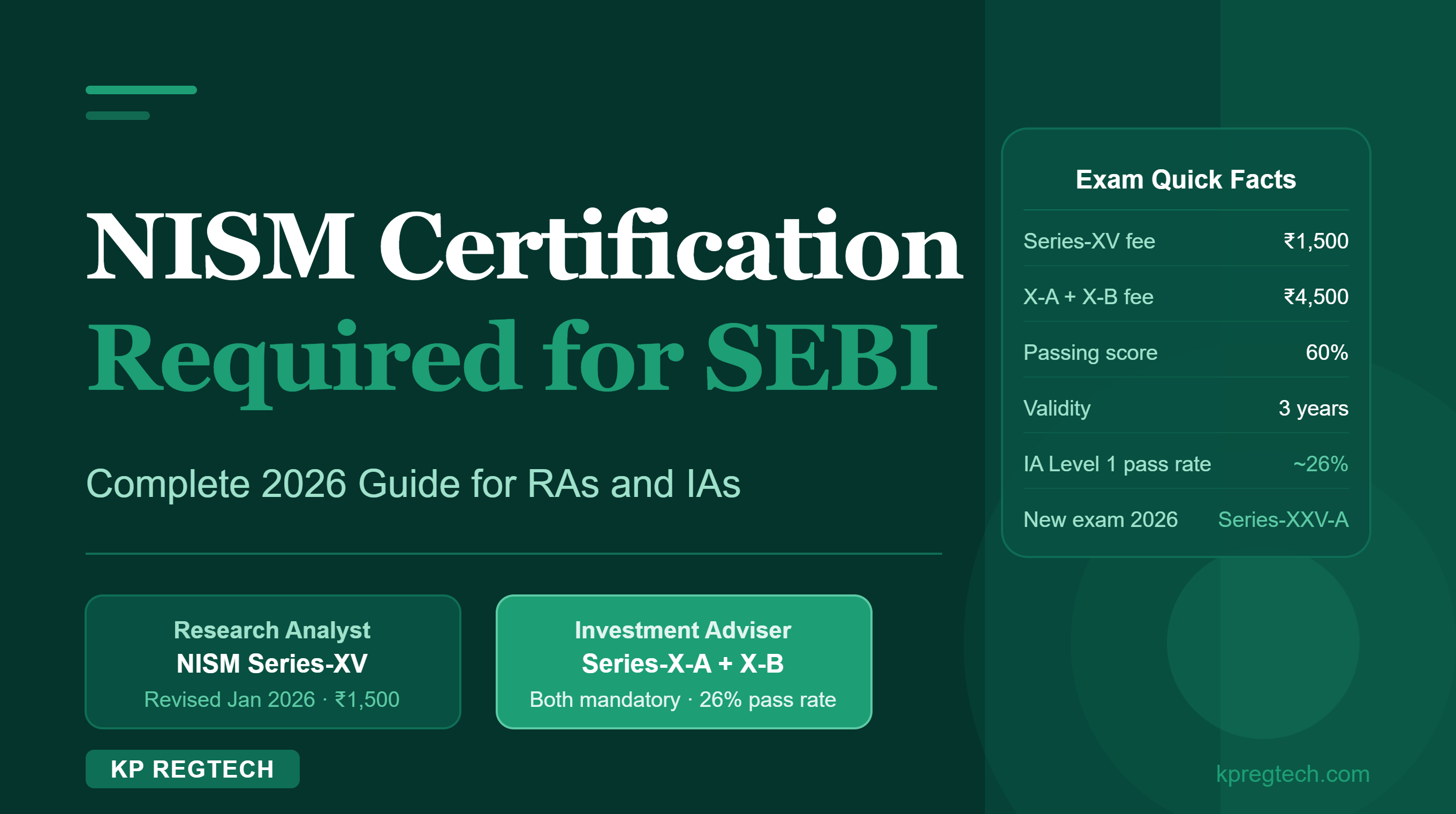
The NISM-Series-XV: Research Analyst Certification Examination is based on Regulation 7(2) of the SEBI (Research Analysts) Regulations, 2014. The examination fee is ₹1,500 plus applicable taxes. The exam duration is two hours and consists of 100 questions. Candidates must score at least 60%, or 60 out of 100 marks, to pass. There is negative marking of 25% of the marks allocated to the question. The certificate is valid for three years from the date of passing. The examination is conducted online at designated NISM test centres across India, and registration is available through nism.ac.in.
The revised January 2026 syllabus covers introduction to capital markets and securities, fundamental analysis and valuation, technical analysis, equity research methodology and report writing, the regulatory framework for Research Analysts, SEBI RA Regulations, 2014 and applicable circulars, compliance obligations including MITC, disclosure requirements and conflict of interest, the model portfolio framework, AI tool usage obligations, and ethics and professional standards.
Passing rate and difficulty: The NISM Series-XV examination is considered moderately difficult. The regulatory and compliance sections added in the January 2026 revision require specific knowledge of the current RA framework — candidates who study only older materials may be underprepared for these sections.
Renewal: The NISM Series-XV certificate is valid for three years. Before expiry, the holder must either pass the NISM-Series-XV-B Renewal Examination or complete a NISM Continuing Professional Education (CPE) programme. Allowing the certificate to expire while registered as an RA creates a compliance gap under Regulation 7(2).
NISM Series-XXV-A: Persons Associated with Research Services Certification Examination
This is a new certification introduced in 2026 specifically for persons associated with research services who perform sales and other non-core functions — not the research analyst function itself.
SEBI Circular dated March 11, 2026 mandated this examination for persons associated with research services in non-core roles — including sales, client servicing, and distribution-related functions within a registered research entity. This certification is not a substitute for the NISM Series-XV for the Principal Officer or research-producing analysts.
This certification applies to staff of registered RA entities who perform sales or client-facing functions related to research services but are not themselves preparing research reports.
It does not apply to individual RAs, Principal Officers of RA entities, or analysts engaged in research preparation. These roles continue to require NISM Series-XV.
NISM Certifications Required for Investment Adviser Registration
Investment Adviser registration requires passing two NISM examinations — both are mandatory. This is the most frequently asked question by IA applicants, and the most common mistake is believing that passing only one of the two exams is sufficient.
NISM Series-X-A: Investment Adviser (Level 1) Certification Examination
This is the first of two mandatory exams for IA registration under the SEBI (Investment Advisers) Regulations, 2013.
The NISM-Series-X-A: Investment Adviser (Level 1) Certification Examination is conducted under the SEBI (Investment Advisers) Regulations, 2013. The examination fee is ₹1,500 plus applicable taxes. The exam duration is two hours and consists of 100 questions. Candidates must score at least 60% to pass. Negative marking is 25% of the marks allocated to the question. The certificate is valid for three years from the date of passing. The exam is conducted online at designated NISM test centres, with registration available through nism.ac.in.
The key syllabus areas include financial planning and the investment planning process, risk profiling and suitability assessment, investment products such as equity, debt, mutual funds, derivatives, insurance and retirement products, tax planning essentials, the regulatory framework for Investment Advisers, SEBI IA Regulations, 2013 and applicable circulars, and client documentation and advisory agreements.
Pass rate: The NISM Series-X-A Level 1 examination has historically had a challenging pass rate — SEBI's own consultation paper on "Ease of Doing Business" cited a pass rate of approximately 26% in FY2023-24. This means approximately three out of four candidates do not clear the exam on their first attempt. Structured preparation — not casual reading — is required.
NISM Series-X-B: Investment Adviser (Level 2) Certification Examination
This is the second mandatory exam for IA registration and must be passed in addition to the Level 1 examination.
The NISM-Series-X-B: Investment Adviser (Level 2) Certification Examination is conducted under the SEBI (Investment Advisers) Regulations, 2013. The examination fee is ₹3,000 plus applicable taxes. The exam duration is three hours and consists of 100 questions. Candidates must score at least 60% to pass. Negative marking is 25% of the marks allocated to the question. The certificate is valid for three years from the date of passing. The examination is conducted online at designated NISM test centres, with registration available through nism.ac.in.
The key syllabus areas include advanced portfolio management, asset allocation strategies, behavioural finance, estate planning and retirement planning, financial plan construction and presentation, advanced regulatory and compliance aspects for Investment Advisers, MITC obligations, the IAASB framework, and current IA Regulations.
Both the Level 1 and Level 2 certificates must be valid at the time of SEBI registration application. If your Level 1 certificate expires before your Level 2 application is filed, you will need to renew Level 1 before proceeding.
NISM Series-III-A: Securities Intermediaries Compliance (Non-Fund) Certification
This certification is required for the Compliance Officer of a non-individual registered Research Analyst or Investment Adviser entity. It is not required for individual RAs or IAs who are the sole registrant.
The NISM Series-III-A certification must be held by the designated Compliance Officer of a non-individual RA or IA entity. This certification is specifically for the compliance function, not the advisory or research function.
The examination fee is ₹1,500 plus applicable taxes and the certification is valid for three years.
Which NISM Certification Do You Need?
For an Individual Research Analyst, the required certification is NISM Series-XV.
For the Principal Officer of a non-individual RA entity, the required certification is NISM Series-XV.
For employees and partners preparing research, NISM Series-XV is required.
For sales and non-core staff of an RA entity, NISM Series-XXV-A is required from March 2026.
For an Individual Investment Adviser, both NISM Series-X-A and NISM Series-X-B are required.
For the Principal Officer of a non-individual IA entity, both NISM Series-X-A and NISM Series-X-B are required.
For persons associated with investment advice performing non-core functions, NISM Series-XXV-B is applicable.
For the Compliance Officer of a non-individual RA or IA entity, NISM Series-III-A is required.
What Happens After You Pass — The Registration Process
Passing the NISM examination is a necessary precondition for SEBI registration but not the complete application. After clearing the required examination, the following steps apply.
For Research Analyst Registration
Enlist with RAASB (BSE Limited as the Research Analyst Administration and Supervisory Body). This is a mandatory pre-registration step introduced in the current RA framework. Submit your NISM certificate, educational qualifications, identity documents, PAN, and address proof to BSE's portal.
Arrange the required RAASB deposit — ₹1 lakh for up to 150 clients, ₹2 lakh for 151–1,000 clients, and ₹5 lakh for above 1,000 clients — as a fixed deposit lien or Liquid/Overnight MF units under lien.
Prepare your compliance policy, code of conduct, KYC procedures, and grievance handling framework. File Form A (RA registration application) on the SEBI intermediary portal along with all supporting documents and the ₹5,000 application fee. Pay the registration fee of ₹10,000 on approval.
For Investment Adviser Registration
Enlist with IAASB (BSE Limited as the Investment Adviser Administration and Supervisory Body). Submit both NISM certificates — Series-X-A and Series-X-B — along with educational qualifications and supporting documents.
Arrange the IAASB deposit — ₹1 lakh for up to 300 clients, ₹2 lakh for 301–1,000 clients, and ₹10 lakh for above 1,000 clients.
Prepare the advisory agreement incorporating the MITC, compliance policy, conflict-of-interest framework, and investor grievance mechanism. Confirm functional website details to IAASB. File the registration application with SEBI along with the application fee.
Practical Preparation Tips for NISM Examinations
Use the official NISM study material. NISM publishes workbooks for each examination on its website (nism.ac.in). These are the primary source — all questions are drawn from the official syllabus. For the revised
NISM Series-XV (January 2026 version), ensure you have the updated workbook, not an older version.
Allow adequate preparation time. The NISM Series-XV requires at least four to six weeks of structured study for most candidates. The NISM Series-X-A — with its 26% historical pass rate — typically requires six to eight weeks of focused preparation.
Complete NISM mock tests before your exam date. NISM provides free mock tests on its portal. These are structured to mirror the actual exam format and negative marking pattern. Candidates who complete multiple mock tests before their exam date significantly improve their accuracy and time management.
Schedule your exam date before applying for SEBI registration. SEBI registration processing typically takes 30–90 days after a complete application is filed. Having your NISM certification in hand before initiating the registration process avoids delays caused by examination scheduling.
Track your certificate expiry date. NISM certificates are valid for three years. If your certificate expires during the SEBI registration process or after registration is granted, you must renew before the expiry date. An expired NISM certificate for a registered RA or IA is a compliance gap under the applicable regulations.
How KP Regtech Helps with SEBI Registration
Passing the NISM examination is the first step. Completing a compliant SEBI registration application — with the correct documentation, a compliant compliance framework, proper MITC, website confirmation, and deposit arrangement — requires specialist regulatory knowledge that goes beyond the NISM syllabus.
At KP Regtech, we support Research Analysts and Investment Advisers through the complete registration process.
Eligibility assessment: We review your educational qualifications, work experience, and background to confirm which registration category applies and whether you meet the eligibility criteria under the current December 2024 framework.
NISM exam guidance: We advise on which certifications you need, the correct sequence, preparation resources, and how to schedule your exam within the overall registration timeline.
Pre-registration compliance framework: Before you file your application, we ensure your compliance policy, code of conduct, advisory agreement, MITC, investor grievance mechanism, and website are all in place —
because SEBI reviews these as part of the registration assessment.
Registration application management: We prepare and manage Form A and all supporting documentation, handle RAASB or IAASB enlistment, arrange deposit documentation, and manage SEBI correspondence throughout the review process.
Post-registration compliance setup: After registration is granted, we set up your annual compliance calendar, ongoing compliance framework, and Compliance-as-a-Service engagement so your first year of operation starts with a complete, current compliance structure.
Contact KP Regtech for a free SEBI registration eligibility assessment →
Frequently Asked Questions
- Which NISM certification is required for SEBI Research Analyst registration?
- Which NISM certifications are required for SEBI Investment Adviser registration?
- Can I apply for SEBI registration before passing NISM?
- How difficult is the NISM Series-XV exam for Research Analysts?
- How difficult is the NISM Series-X-A for Investment Advisers?
- How long is an NISM certificate valid?
- Do employees of a registered RA firm also need NISM Series-XV?
- What is the NISM Series-XXV-A and who needs it?
- What is the total cost of NISM certifications for RA and IA registration?
- How can KP Regtech help with NISM certification and SEBI registration?
Disclaimer: This article is for informational purposes only and does not constitute legal or regulatory advice. Candidates should verify current exam details, fees, and syllabus on the official NISM website (nism.ac.in) before registering for examinations.