
For many SEBI-registered Investment Advisers (IAs), compliance is often associated with annual audits and regulatory filings. While these obligations are undoubtedly important, limiting compliance activities to a once-a-year exercise can expose an advisory practice to significant regulatory and operational risks.
SEBI's regulatory framework expects Investment Advisers to maintain continuous compliance with the SEBI (Investment Advisers) Regulations, 2013, applicable Master Circulars, and various operational requirements. Client onboarding, disclosures, grievance handling, record maintenance, advertisements, website updates, and internal governance all require ongoing attention throughout the year.
This is where internal compliance reviews become invaluable. They allow advisers to periodically assess whether their business practices continue to comply with regulatory requirements, identify deficiencies before they are discovered during an inspection or audit, and implement corrective measures in a timely manner.
Although SEBI prescribes an annual compliance audit, there is no regulatory requirement that internal reviews be conducted only once a year. In fact, regular internal assessments are considered a best practice for maintaining a robust compliance culture.
This guide explains how frequently Investment Advisers should conduct internal compliance reviews, what those reviews should cover, and how they contribute to stronger governance and reduced regulatory risk.
What Is an Internal Compliance Review?
An internal compliance review is a structured assessment of an Investment Adviser's compliance framework, policies, records, and day-to-day operations. Unlike the statutory annual compliance audit, an internal review is conducted by the organisation itself or with the assistance of an external compliance consultant to identify potential gaps before they become regulatory issues.
The purpose is not merely to verify whether documents exist but to evaluate whether compliance systems are functioning effectively in practice.
An effective review examines operational processes, documentation, regulatory updates, employee practices, technology systems, and governance controls to determine whether the firm continues to comply with applicable SEBI requirements.
Internal reviews also provide management with an opportunity to improve processes, update policies, and strengthen internal controls.
Why Internal Compliance Reviews Are Important
Regulations governing Investment Advisers continue to evolve as SEBI introduces amendments, clarifications, circulars, and updated governance expectations. At the same time, advisory businesses themselves undergo continuous change through new clients, additional employees, technology upgrades, digital platforms, marketing initiatives, and business expansion.
Without periodic reviews, small compliance deficiencies can remain unnoticed for months until they are identified during an audit, investor complaint, or regulatory inspection.
Regular internal reviews enable advisers to detect issues early, implement corrective action promptly, and maintain a culture of continuous compliance rather than reactive compliance.
They also demonstrate that senior management actively monitors regulatory obligations instead of treating compliance as an annual formality.
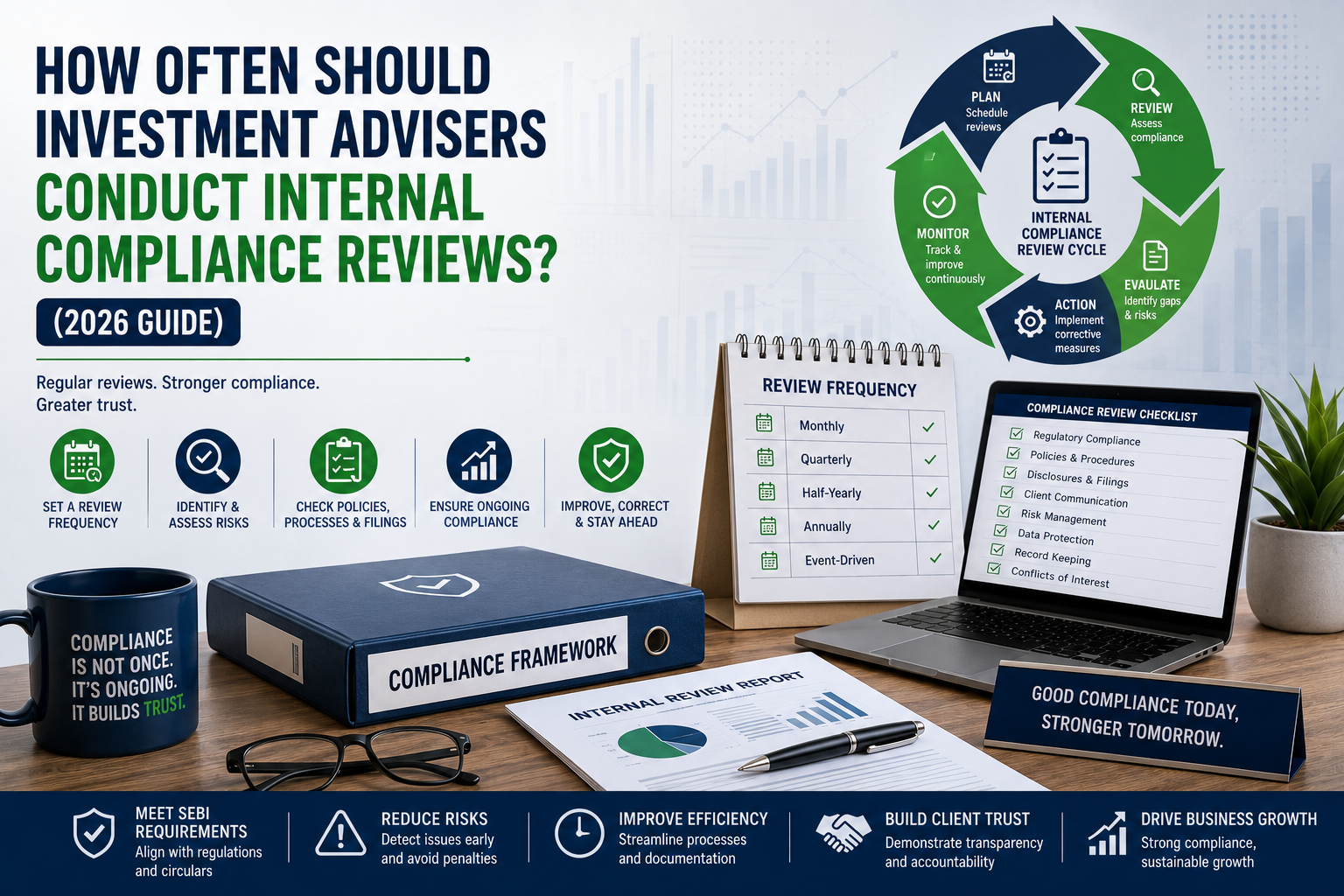
How Often Should Investment Advisers Conduct Internal Reviews?
There is no single frequency prescribed under the regulations. The appropriate review cycle depends on the size, complexity, and nature of the advisory business. However, from a governance perspective, relying solely on the annual compliance audit is generally not advisable.
For most Investment Advisers, a quarterly internal compliance review represents a practical and effective approach. Reviewing compliance every three months allows firms to monitor regulatory obligations regularly without creating unnecessary administrative burden.
Smaller advisory firms with limited operations may choose to conduct comprehensive reviews every six months, provided ongoing compliance activities continue to be monitored between formal reviews.
Larger organisations, firms with multiple advisory teams, rapidly growing businesses, or entities using extensive digital infrastructure may benefit from monthly compliance monitoring combined with more detailed quarterly reviews.
The key objective is to identify compliance issues while they remain manageable rather than waiting until the annual audit.
What Should an Internal Compliance Review Cover?
An internal compliance review should evaluate the effectiveness of the firm's overall compliance framework rather than focusing only on statutory filings.
The review should examine whether client onboarding procedures remain compliant, mandatory disclosures are being provided consistently, records are maintained accurately, and internal policies reflect the latest regulatory requirements.
It should also assess grievance redressal mechanisms, advisory agreements, fee collection practices, conflict management procedures, employee declarations, and documentation supporting regulatory compliance.
Where the Investment Adviser maintains a website or digital platform, website disclosures, investor information, advertisement compliance, privacy practices, and cybersecurity measures should also be reviewed periodically.
The objective is to ensure that compliance is embedded throughout the organisation rather than concentrated in isolated functions.
Reviewing Regulatory Documentation
Documentation forms the backbone of any effective compliance programme.
During each internal review, firms should verify that mandatory policies remain current, disclosures are consistent across client-facing documents, agreements reflect applicable regulations, and records are maintained in an organised manner.
Changes in business operations often require corresponding updates to documentation. Failure to revise internal policies following regulatory amendments can result in inconsistencies that become evident during inspections or audits.
Regular document reviews help ensure that compliance documentation accurately reflects the firm's actual operating practices.
Monitoring Client Onboarding and Advisory Practices
Client onboarding represents one of the most important operational areas for Investment Advisers.
Internal reviews should assess whether onboarding procedures continue to follow regulatory requirements, client risk profiling is properly documented, suitability assessments are completed, advisory agreements are executed appropriately, and mandatory disclosures are communicated before advisory services commence.
Periodic review of actual client files provides valuable insight into whether internal procedures are being consistently followed across the organisation.
Strong onboarding practices also reduce the likelihood of future investor complaints.
Reviewing Technology, Website and Data Protection
Investment Advisers increasingly depend on websites, client portals, cloud platforms, CRM systems, and digital communication channels.
Internal reviews should therefore include an assessment of website compliance, cybersecurity controls, access management, privacy practices, backup procedures, and compliance with the Digital Personal Data Protection (DPDP) Act, 2023 where applicable.
As technology becomes central to advisory services, digital governance should form an integral part of every compliance review rather than being treated as a separate IT exercise.
Employee Awareness and Training
Even well-designed compliance frameworks become ineffective if employees do not understand their responsibilities.
Periodic internal reviews should assess whether employees remain familiar with current regulatory requirements, internal policies, conflict management procedures, confidentiality obligations, and cybersecurity practices.
Where gaps are identified, additional training sessions should be organised to reinforce compliance awareness throughout the organisation.
Investing in employee education often prevents compliance failures caused by human error.
Preparing for Annual Compliance Audits
One of the greatest advantages of periodic internal reviews is that they simplify preparation for the statutory annual compliance audit.
By identifying deficiencies throughout the year, firms avoid the pressure of attempting to resolve multiple issues immediately before the audit. Documentation remains organised, corrective actions are implemented progressively, and management gains confidence that compliance systems are operating effectively.
Consequently, annual audits become confirmation of ongoing compliance rather than emergency compliance exercises.
Common Issues Identified During Internal Reviews
Internal compliance reviews frequently reveal operational gaps that develop gradually as businesses grow.
Examples include outdated policies, incomplete client documentation, inconsistencies in disclosures, website information requiring updates, deficiencies in advertisement review procedures, inadequate record retention, delayed grievance resolution, employee access management issues, and insufficient documentation supporting advisory processes.
Most of these deficiencies can be corrected quickly when identified through periodic reviews, preventing larger regulatory concerns in the future.
Developing a Continuous Compliance Culture
The most successful Investment Advisers view compliance as a continuous management function rather than a regulatory obligation performed once every year.
Periodic reviews encourage proactive governance, improve operational discipline, strengthen investor confidence, and reduce regulatory uncertainty. They also help management identify opportunities to improve efficiency while maintaining compliance with evolving regulations.
As regulatory expectations continue to increase, firms that adopt structured internal review programmes will generally be better prepared for audits, inspections, and future regulatory developments.
How KP RegTech Supports Investment Advisers
At KP RegTech, we assist SEBI-registered Investment Advisers in establishing practical compliance systems that extend beyond statutory audits. Our services include quarterly and half-yearly internal compliance reviews, annual compliance audits, compliance framework development, website compliance, advertisement review, inspection readiness, regulatory documentation, DPDP compliance advisory, governance support, and ongoing compliance retainership.
Our multidisciplinary team works closely with Investment Advisers to identify compliance gaps early, strengthen governance processes, and maintain continuous regulatory compliance throughout the year.
Frequently Asked Questions
Does SEBI require quarterly internal compliance reviews?
SEBI mandates annual compliance audits for Investment Advisers under the applicable regulatory
framework. While quarterly internal reviews are not specifically mandated, they are widely regarded as a governance best practice that helps maintain continuous compliance.
Are internal reviews different from annual compliance audits?
Yes. Internal reviews are proactive assessments conducted by the organisation or its compliance consultant throughout the year, whereas the annual compliance audit is a statutory requirement carried out in accordance with SEBI regulations.
Can small Investment Advisers conduct reviews every six months?
Smaller firms may conduct formal reviews every six months if their operations are limited. However, ongoing monitoring of compliance obligations should continue throughout the year.
Should website compliance be included in internal reviews?
Yes. Websites should be reviewed periodically to ensure regulatory disclosures, investor information, advertisement practices, privacy notices, and other mandatory content remain accurate and compliant.
Why are internal compliance reviews important?
They help identify compliance gaps early, strengthen governance, improve documentation, simplify annual audits, and reduce the risk of regulatory action arising from preventable deficiencies.
Conclusion
Internal compliance reviews are one of the most effective tools available to SEBI-registered Investment Advisers for maintaining continuous regulatory compliance. Rather than relying solely on the annual compliance audit, advisers should adopt a structured programme of periodic reviews that examines documentation, operational processes, digital governance, client onboarding, employee awareness, and regulatory developments. A proactive approach to compliance not only reduces regulatory risk but also strengthens governance, enhances investor confidence, and prepares firms for long-term sustainable growth in an increasingly regulated financial services environment.