
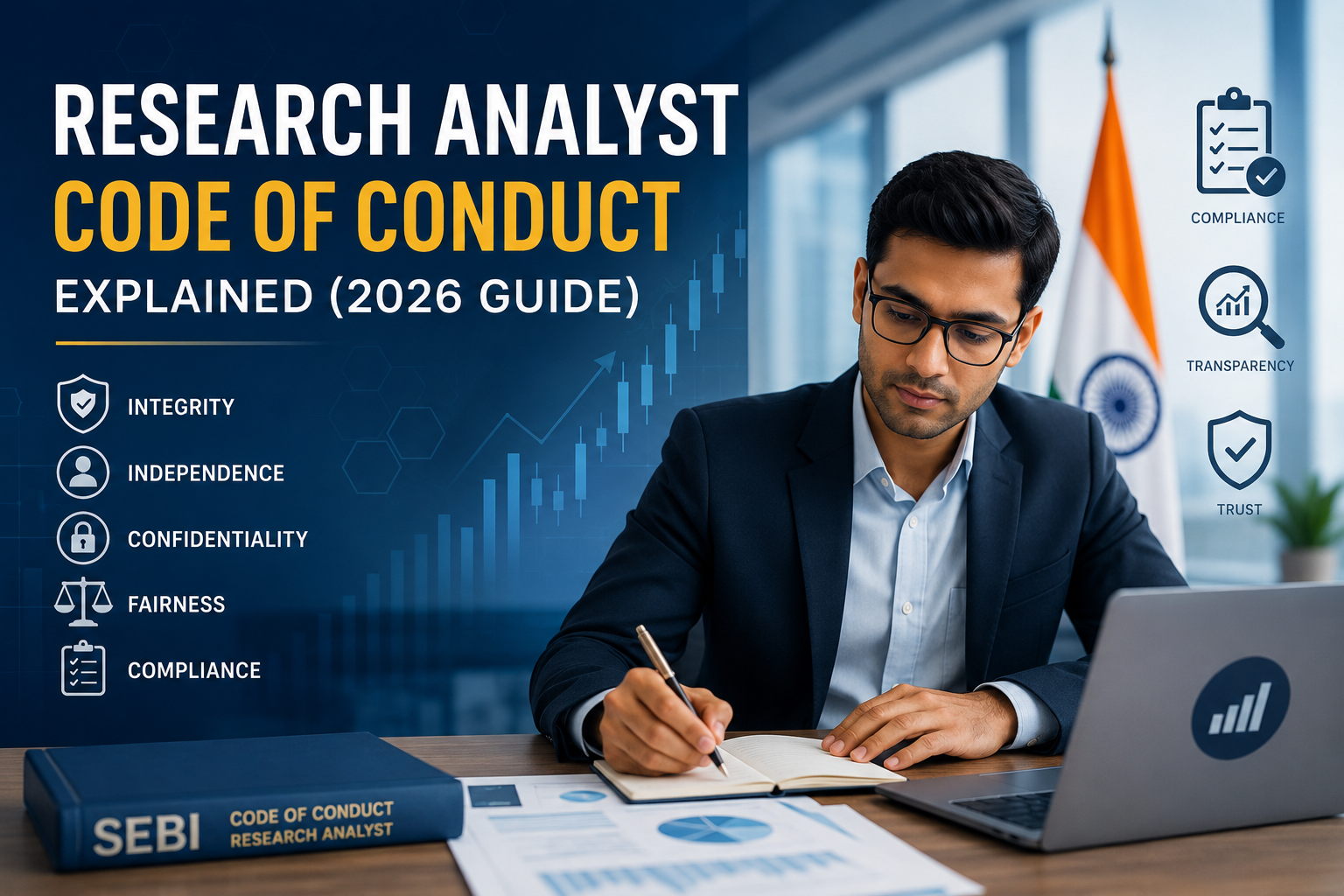
The success of India's securities market depends significantly on the credibility of investment research. Investors often rely on research reports and recommendations before making financial decisions, which places a high level of responsibility on every SEBI-registered Research Analyst. To ensure that research remains objective and trustworthy, the SEBI (Research Analysts) Regulations, 2014, prescribe a comprehensive Code of Conduct that governs the professional behaviour of Research Analysts.
The Code of Conduct is not merely an ethical guideline. It forms an integral part of a Research Analyst's regulatory obligations and reflects SEBI's expectation that research should always be prepared with honesty, independence, competence, and fairness. Whether an entity is an individual Research Analyst or a corporate research firm, adherence to these principles is essential for maintaining investor confidence and avoiding regulatory action.
In recent years, SEBI has strengthened its focus on governance, conflict management, disclosure standards, and investor protection. As regulatory expectations continue to evolve, Research Analysts should regularly review their compliance framework to ensure that day-to-day operations remain aligned with the Code of Conduct.
This guide explains the principles of the Research Analyst Code of Conduct in simple language and discusses how they apply in practical situations.
Understanding the Research Analyst Code of Conduct
The Code of Conduct is prescribed under the SEBI (Research Analysts) Regulations and applies to every registered Research Analyst and persons associated with research activities. It establishes the ethical standards that should guide every stage of the research process—from gathering information and analysing companies to preparing reports and communicating recommendations to clients.
The objective is to ensure that investors receive research that is based on independent professional judgement rather than personal interests or commercial influence. Research reports should present balanced analysis, disclose material information wherever required, and enable investors to make informed decisions without being misled.
The Code also encourages firms to establish internal systems that promote transparency, accountability, and regulatory compliance throughout the organisation.
Why the Code of Conduct Matters
Investment research directly influences investor behaviour. If research is biased, promotional in nature, or affected by undisclosed financial interests, investors may suffer significant losses while confidence in the securities market declines.
The Research Analyst Code of Conduct seeks to eliminate these risks by requiring Research Analysts to maintain high professional standards in every interaction with clients and the market. It promotes transparency in recommendations, strengthens investor protection, and creates confidence that published research is prepared objectively.
For Research Analysts, compliance with the Code is equally important from a regulatory perspective. During inspections or compliance audits, SEBI may evaluate whether adequate policies, documentation, disclosures, and internal controls exist to demonstrate adherence to these ethical standards.
Honesty, Integrity and Fair Dealing
One of the fundamental principles of the Code of Conduct is that every Research Analyst must conduct business honestly and with integrity. Research reports should accurately represent the analyst's professional opinion and should never contain false, misleading, or exaggerated statements intended to influence investors improperly.
Professional integrity also requires analysts to avoid suppressing material information that may significantly affect an investment recommendation. Investors should receive balanced research that discusses both opportunities and associated risks rather than presenting only favourable information.
Maintaining honesty in research enhances long-term credibility and strengthens investor confidence in both the analyst and the broader securities market.
Independence and Objectivity
Perhaps the most important aspect of the Code of Conduct is the requirement to maintain independence while preparing research.
A Research Analyst's opinion should always be formed through objective analysis rather than external influence. Recommendations should never be affected by commercial relationships, issuer pressure, sales targets, brokerage incentives, or personal financial interests.
Maintaining independence is not simply a matter of intent. Organisations should establish internal policies that identify potential conflicts of interest, require appropriate disclosures, and ensure that research functions remain insulated from business decisions that could compromise objectivity.
When investors believe research is independent, they are far more likely to rely upon it when making investment decisions.
Managing Conflicts of Interest
Conflicts of interest represent one of the most closely monitored areas of Research Analyst regulation.
A conflict may arise whenever an analyst's personal, financial, or professional interests have the potential to influence research recommendations. Such situations do not necessarily imply misconduct, but they must be identified, managed appropriately, and disclosed wherever required under applicable regulations.
Research Analysts should implement written policies addressing employee investments, personal trading, outside business interests, gifts and hospitality, compensation arrangements, and relationships with companies covered in research reports.
An effective conflict management framework protects both investors and the Research Analyst by demonstrating that recommendations are based on independent professional judgement.
Disclosure Requirements
Transparency is central to the Research Analyst framework established by SEBI.
Research reports should include all disclosures required under the applicable regulatory framework so that investors understand any circumstances that could influence the recommendation. Depending upon the facts of a particular case, disclosures may relate to financial interests, ownership positions, business relationships, compensation arrangements, or other material conflicts.
Accurate disclosures enable investors to evaluate research in the proper context while also reducing regulatory risk for the Research Analyst.
Many compliance deficiencies identified during audits arise not because research quality is poor, but because mandatory disclosures are incomplete or not presented consistently across reports.
Professional Competence and Due Diligence
The Code of Conduct expects every Research Analyst to exercise due skill, care, and diligence while preparing research.
Recommendations should be supported by reasonable analysis, reliable information, and appropriate research methodologies. Analysts should avoid relying upon rumours, market speculation, or unverified information when preparing investment recommendations.
Professional competence also requires continuous learning. Regulatory amendments, accounting developments, and changes in market practices should be monitored regularly so that research continues to meet current professional standards.
Confidentiality and Protection of Client Information
Research Analysts frequently have access to confidential client information and sensitive business records. The Code of Conduct requires that such information be protected and used only for legitimate professional purposes.
Confidential information should never be disclosed without proper authorisation or used to obtain personal financial benefit. Firms should establish internal procedures governing information security, access controls, record retention, and employee responsibilities regarding confidential data.
Maintaining confidentiality not only satisfies regulatory expectations but also strengthens client confidence in the firm's professional practices.
Fair Communication with Investors
Research reports and investor communications should always be clear, balanced, and capable of being understood by an ordinary investor.
Research Analysts should avoid language that creates unrealistic expectations or guarantees investment returns. Statements suggesting assured profits or presenting speculative opinions as certain outcomes may expose both the firm and investors to unnecessary risk.
Every communication should accurately reflect the research performed and present investment risks alongside potential opportunities.
This principle also extends to advertisements, websites, social media posts, webinars, and other public communications published by the Research Analyst.
Record Keeping and Compliance Systems
Compliance with the Code of Conduct extends beyond preparing research reports. Firms should maintain proper records demonstrating that research recommendations were prepared using appropriate processes and supported by relevant documentation.
A robust compliance framework generally includes documented policies, conflict management procedures, employee declarations, periodic compliance reviews, research documentation, and records of client communications.
These records become particularly important during SEBI inspections, annual compliance audits, or internal compliance reviews, where regulators may seek evidence that ethical standards are being implemented in practice rather than existing only on paper.
Common Compliance Challenges
Many regulatory observations relating to Research Analysts arise from operational weaknesses rather than intentional misconduct.
Common issues include inconsistent disclosures, inadequate documentation, weak conflict management procedures, insufficient review of marketing material, failure to maintain updated compliance records, and absence of written internal policies.
These deficiencies can usually be addressed through periodic compliance reviews, employee training, and regular updates to internal processes.
Building a Strong Compliance Culture
Compliance should not be viewed as a once-a-year exercise conducted only for regulatory inspections or annual audits. Instead, the principles of the Code of Conduct should form part of the organisation's everyday operations.
Research firms that invest in strong governance, regular compliance monitoring, documented internal controls, and continuous employee awareness are generally better prepared to meet regulatory expectations while building long-term credibility with investors.
An effective compliance culture also reduces operational risk, improves consistency in research practices, and enhances the firm's reputation in the market.
How KP RegTech Supports Research Analysts
Maintaining compliance with the Research Analyst Code of Conduct requires more than understanding the regulations—it requires practical systems, documentation, and ongoing monitoring.
KP RegTech assists SEBI-registered Research Analysts with annual compliance audits, regulatory documentation, compliance framework development, advertisement compliance reviews, inspection readiness, website compliance, ongoing compliance retainership, and other secretarial and regulatory support services. Our multidisciplinary team works closely with Research Analysts to establish practical compliance processes that align with the latest SEBI requirements while reducing regulatory risk.
Frequently Asked Questions
Is the Research Analyst Code of Conduct legally binding?
Yes. The Code of Conduct forms part of the SEBI (Research Analysts) Regulations, 2014, and compliance is mandatory for every registered Research Analyst.
Why is independence so important?
Independent research ensures that investment recommendations are based solely on professional analysis rather than commercial influence or personal interests, thereby protecting investors.
Are conflict disclosures mandatory?
Where applicable under the regulations, material conflicts of interest should be disclosed so that investors can properly assess the research recommendation.
Does the Code apply only to research reports?
No. The principles of the Code extend to all professional conduct, including client communications,
advertisements, websites, public appearances, and other activities connected with research services.
How often should Research Analysts review their compliance framework?
Compliance systems should be reviewed periodically, particularly after regulatory amendments, organisational changes, or observations identified during internal reviews or annual compliance audits.
Conclusion
The Research Analyst Code of Conduct represents the cornerstone of ethical investment research in India. By emphasising honesty, independence, transparency, professional competence, and investor protection, it helps ensure that research recommendations remain reliable and free from undue influence. As SEBI continues to strengthen its regulatory framework, Research Analysts should treat the Code not merely as a statutory obligation but as an integral part of building a credible and sustainable research practice. Regular compliance reviews, strong internal governance, and well-documented policies remain essential for meeting regulatory expectations and maintaining the confidence of investors.