
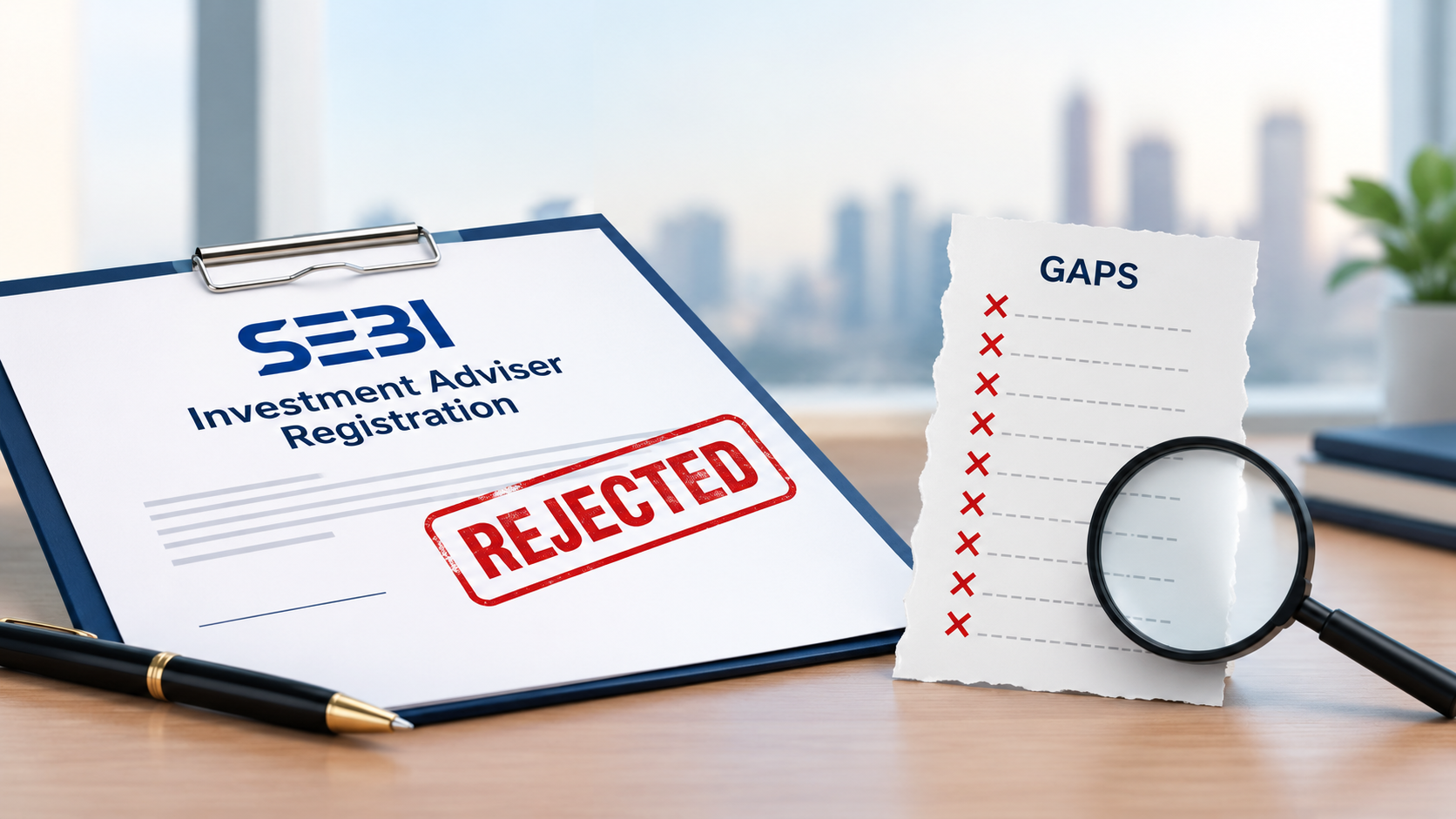
Most Investment Adviser applicants spend weeks collecting documents. Far fewer spend an hour checking whether their structure, qualifications and business model actually fit the regulations.
That gap is where applications get queried, delayed or sent back, and where launch dates quietly slip by months.
Under the SEBI (Investment Advisers) Regulations, 2013, an application is not just a file that gets stamped. It is assessed against eligibility, qualification, net worth, infrastructure and fit-and-proper requirements. A complete set of documents can still describe an applicant who does not qualify, or a business that does not match the registration being sought.
Here are nine gaps worth closing before you file.
What a setback actually costs
Before the list, consider what is at stake. A rejected or long-stalled application can mean:
• Lost time. Months of delay while you correct the issue, respond to queries or re-apply.
• Idle spend. Incorporation, office, technology, domain and marketing costs with no registration to use them.
• Paid-for certifications that don't fit. Exams cleared for the wrong person or the wrong category of registration.
• A stalled launch. Clients, partners and hires waiting on a registration that is not coming.
• Fees and effort repeated. Statutory fees, professional fees and preparation work, all done again.
None of these is inevitable. Almost all are avoidable if the issues are found before filing rather than during scrutiny.
1. You assumed you were eligible instead of checking
The consequence: An applicant who does not meet the requirements cannot be fixed with better paperwork.
Experience in the markets does not replace the prescribed educational qualification, certification and experience conditions. Eligibility also depends on whether you are applying as an individual or a non-individual, and on who within the entity must meet which requirement.
A typical scenario: A trader with years of market experience plans to apply, but has not confirmed whether their educational background and certification satisfy the prescribed conditions. The gap surfaces only after the application is filed.
What to do: Test your eligibility against the current regulations before you spend on incorporation, infrastructure or marketing.
2. You picked the wrong structure
The consequence: A structure that is cheap or convenient today can stop fitting the business later, and changing it means more cost and more delay.
Individual, company or LLP: each comes with different requirements, including net worth, and different rules on who must be qualified. The structure should follow from the business you actually intend to run.
A typical scenario: A founder applies as an individual, then plans to hire a team and add a technology-led advisory feature. Within months, the structure no longer fits the business.
What to do: Decide the structure based on where the business will be in two to three years, not only on the cost of setting it up.
3. Your qualifications and certifications are mapped incorrectly
The consequence: Holding a certificate is not the same as holding the right certificate for the right person.
Applicants often focus on one exam. The requirements, including the NISM Series X-A and X-B certifications, can depend on your structure and on who within the entity gives investment advice. They have also changed through amendments and circulars over time.
What to do: List every person who must be qualified, confirm what each must hold, and check certificate validity. Verify everything against the current regulations and SEBI's Master Circular for Investment Advisers, not an old checklist.
4. Your documents are complete but contradict each other
The consequence: Inconsistency invites questions, and questions mean delay.
If your business plan describes one set of services, your website promises another, and your organisational documents show a third arrangement, each document may be fine alone, but together they raise doubts.
A typical scenario: The application describes pure advisory, while the website advertises stock tips, portfolio services and a link to open a broking account.
What to do: Read all your materials side by side before filing: forms, declarations, business plan, constitutional documents, qualification evidence and your website. They should tell one story.
5. You Overlooked the Mandatory Deposit Requirement
The consequence: Failing to understand or arrange the applicable deposit requirement can create an avoidable obstacle in your registration preparation.
SEBI replaced the earlier net-worth requirements for Investment Advisers with a deposit requirement under Regulation 8 of the SEBI (Investment Advisers) Regulations, 2013. The prescribed deposit is linked to the applicable client-count category.
The specified deposit slabs are:
- Up to 150 clients: Rs. 1 lakh
- 151–300 clients: Rs. 2 lakh
- 301–1,000 clients: Rs. 5 lakh
- 1,001 clients and above: Rs. 10 lakh
What to do: Understand the deposit framework applicable to your proposed registration and plan for the associated financial and procedural requirements. Do not rely on outdated net-worth checklists or assume that the deposit requirement can be ignored simply because you are a new applicant.
Before filing, verify the latest applicable SEBI and IAASB requirements, including how the deposit is to be maintained and evidenced for your application.
6. You didn't separate advice from distribution
The consequence: Mixing advisory with commissions or distribution is one of the most scrutinised areas for Investment Advisers.
The regulations require segregation between investment advice and distribution activities. For individual advisers this extends to the client level and to family relationships. Business models that blur this line need careful analysis before filing.
What to do: Map every revenue stream and affiliated activity. If any involves distribution, referral commissions or execution, get it assessed before you apply.
7. You haven't examined what your platform actually does
The consequence: The label "investment advisory" on your application may not match what your product does.
Research content, screeners, rankings, model portfolios, automated recommendations and execution features can each carry different regulatory implications. This matters most for fintech founders and robo-advisory platforms.
A typical scenario: A founder builds an app that ranks stocks and recommends portfolios, files as an Investment Adviser, and only later learns that some features need separate regulatory analysis.
What to do: Document exactly what your platform or service does, and test each feature against the regulations before you file.
8. You treated fit-and-proper as a formality
The consequence: An inaccurate or incomplete declaration is far more damaging than the underlying issue it was meant to disclose.
Fit-and-proper criteria apply to the applicant and connected persons, such as directors, partners and principal officers. Past regulatory or disciplinary history, or pending proceedings, needs honest evaluation.
Not every past issue is disqualifying, and none can be ignored.
What to do: If anything in your background or that of a connected person could be relevant, get an informed assessment before filing.
9. You filed without a full pre-submission review
The consequence: Small gaps compound. A wrong structure, a mismatched certificate and an inconsistent website can each be manageable alone. Together, they can stall an application.
A complete review looks at the whole application: eligibility, structure, net worth, certifications, activities, infrastructure and documentation, and identifies open dependencies before submission.
What to do: Review the application as SEBI's reviewer will see it, not as the preparer sees it.
Can SEBI reject an Investment Adviser application?
Yes. SEBI may refuse to grant registration where it concludes the applicant does not meet the requirements, following the procedure prescribed in the regulations, which includes giving the applicant a reasonable opportunity to be heard.
It helps to separate two situations. A deficiency such as a missing document or an unclear explanation can often be corrected in response to a query. An eligibility or suitability issue such as an unmet qualification or net worth requirement is much harder to fix. Filing before you know which kind of issue you have is what puts timelines at risk.
Queries themselves are not a sign of failure. What matters is whether your answers are accurate, consistent with the original application and backed by evidence. A reply that merely repeats the original submission rarely resolves the concern.
Your pre-filing checklist
• Eligibility checked against current requirements
• Structure matched to your actual business plan
• Every required person mapped to the right qualification and certification
• Deposit requirement met and evidenced
• Advice and distribution activities clearly separated
• Documents, website and business plan consistent with each other
• Every platform feature tested against the regulations
• Fit-and-proper declarations reviewed for accuracy
• Process ready for responding to queries and maintaining records
Frequently Asked Questions (FAQs)
1. Can I reapply for SEBI Investment Adviser registration if my application is rejected?
A previous rejection does not necessarily mean that you can never apply again. However, the appropriate course of action depends on the reasons for rejection, the applicant's circumstances and the applicable regulatory requirements. SEBI's assessment may take into account whether the applicant or a person connected with the applicant was previously refused registration and the grounds for that refusal. Before making another application, the reasons for rejection should be carefully examined and the underlying issues addressed. Reapplying without resolving those issues may not be an effective approach.
2. How long does SEBI Investment Adviser registration take?
The time required for registration depends on the completeness of the application, the applicant's eligibility and documentation, the proposed business structure, and any clarifications or additional information requested during the process. Applicants should allow sufficient time for preparation, submission and subsequent regulatory assessment. A fixed approval timeline should not be assumed, and no consultant can guarantee the date on which registration will be granted.
3. Does receiving a query from SEBI mean that my application will be rejected?
No. A query or request for additional information does not, by itself, mean that an application will be rejected. The important consideration is whether the issue raised is understood and addressed accurately, with appropriate explanations and supporting documents where required. Applicants should respond carefully and ensure that their replies remain consistent with the application and the applicable regulatory requirements.
4. Can a consultant guarantee approval of my SEBI Investment Adviser registration?
No consultant can guarantee approval. The registration decision rests with SEBI and depends on the applicable regulatory requirements and the facts of the application. A competent consultant can help assess eligibility, identify potential gaps, prepare supporting documentation and assist with regulatory queries within the agreed scope of engagement. Applicants should be cautious of assurances that approval is certain or that regulatory scrutiny can be bypassed.
5. Can I apply for SEBI Investment Adviser registration without meeting the applicable deposit requirement?
Applicants should verify the deposit requirements applicable to their category and circumstances before proceeding. The earlier net-worth framework has been replaced by a deposit-based framework under the applicable SEBI regulations. The relevant deposit requirements, including the manner in which the deposit must be maintained and evidenced, should be confirmed against the latest SEBI and IAASB requirements before filing.
6. Should I choose an Investment Adviser registration consultant based only on professional fees?
Professional fees are an important consideration, but applicants should also evaluate the scope of work. Ask whether the engagement includes eligibility assessment, review of the proposed business structure, documentation support, application preparation and assistance with regulatory queries. Clarify exclusions, statutory fees and other expenses in advance. Comparing the actual scope of services can help applicants make a more informed decision than comparing fees alone.
7. Can KP RegTech assist with SEBI Investment Adviser registration from start to finish?
KP RegTech provides Investment Adviser registration support, subject to the agreed scope of engagement. Depending on the applicant's requirements, the support may include an initial eligibility and structure assessment, guidance on applicable regulatory requirements, policy and documentation assistance, application preparation and assistance with queries raised by SEBI or the relevant recognised body. The proposed scope and professional fees should be confirmed based on the applicant's circumstances. Registration approval remains subject to SEBI's decision.
Find the gaps before SEBI does
Fixing an issue before you file is faster and cheaper than fixing it mid-application, and far cheaper than starting over.
KP RegTech works exclusively on Research Analyst and Investment Adviser compliance. Book a free 15-minute eligibility check and we will tell you where your application stands on eligibility, structure and certifications, and which gaps to close first.
KP RegTech | Research Analyst & Investment Adviser Compliance Specialists
Website: https://kpregtech.com/
Phone: +91 96255 81998
Schedule a consultation now
Disclaimer: This article is for general educational and informational purposes only. It is not legal advice and does not guarantee registration. Regulatory requirements change, and registration decisions rest with SEBI. Please review the applicable regulations, circulars and your own facts before applying.