
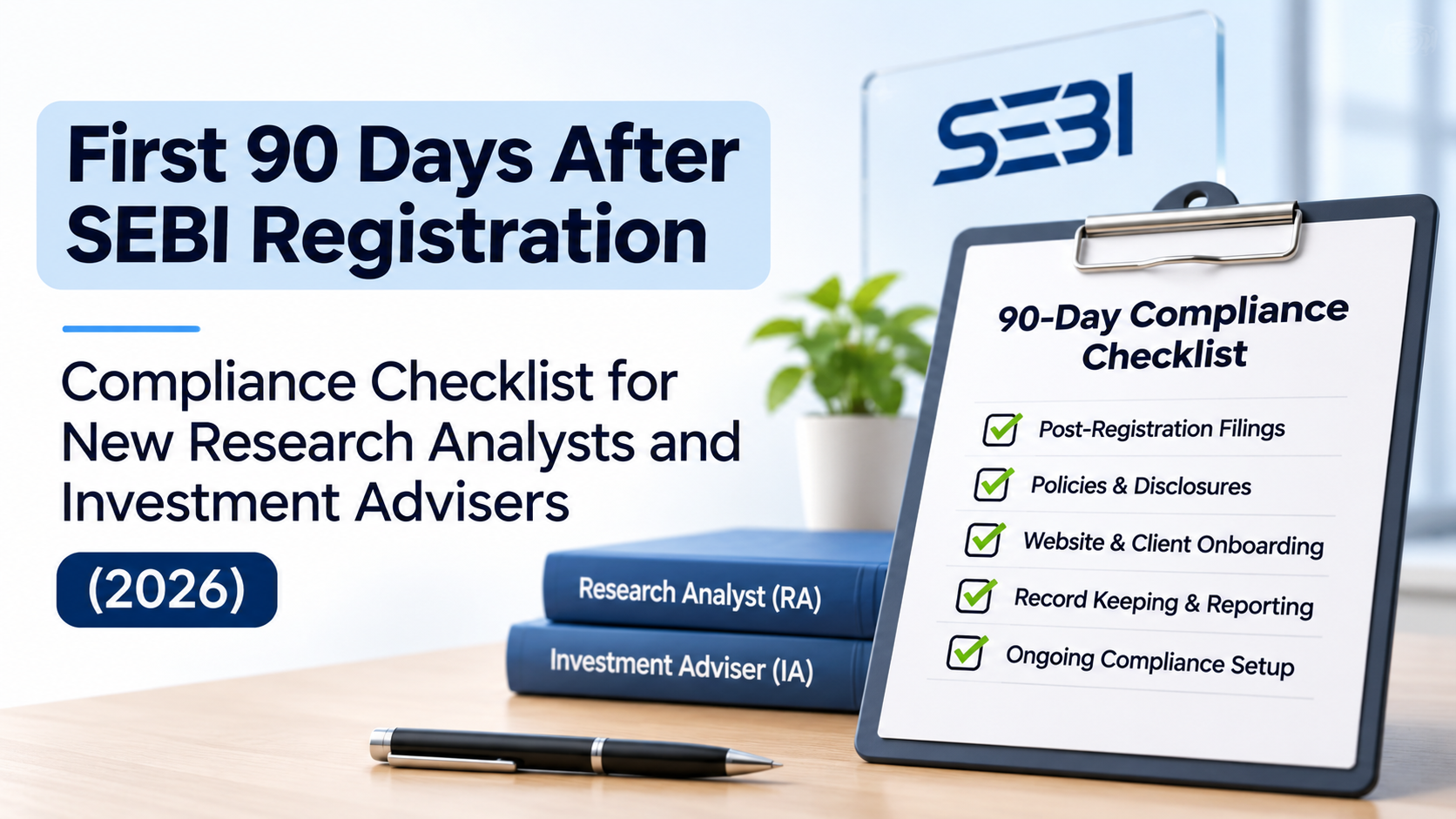
First 90 Days After SEBI Registration: Compliance Checklist for New Research Analysts and Investment Advisers (2026)
In the first 90 days a new Research Analyst (RA) or Investment Adviser (IA) should do six things before taking paid clients: confirm the deposit and lien, display registration details on the website and social media, finalise client terms and MITC, set up KYC and five-year record-keeping, fix fees within SEBI’s caps, and diarise the half-yearly report and annual audit dates. The details and deadlines are below.
Key dates every new RA and IA should diarise
Every month. Publish investor-complaint data on your website and app by the 7th of the following month. This applies to both RAs and IAs.
Every half-year. File the periodic report with RAASB or IAASB within 30 days of 30 September and 31 March, which means by 30 October and 30 April.
Every year. If client numbers moved you into a new deposit slab, revise the deposit by 30 April. Complete the annual compliance audit within six months of the financial year end, that is by 30 September. Submit the audit report, with action taken on adverse findings, within one month of the audit report and not later than 31 October.
Ongoing. Obtain a fresh NISM certification before the current certificate expires.
Days 1 to 15: registration details, deposit and website
1. Show your registered name and number everywhere
Put your registered name, registration type and registration number (INH for RAs, INA for IAs) on your website, mobile app, research reports, advisory documents, emails and invoices.
SEBI’s circular of 26 February 2026, in force from 1 May 2026, also requires the registered name and number on the home page of every social media handle and at the start of each securities-market video or post. This covers YouTube, Instagram, X, LinkedIn, WhatsApp and Telegram, including closed groups. If you hold more than one SEBI registration, add a link on the handle to a web page that lists all of them.
2. Confirm the deposit and lien
Regulation 8 of both sets of regulations requires a deposit, sized by the maximum number of clients on any day of the previous financial year.
The deposit is ₹1 lakh for up to 150 clients, ₹2 lakh for 151 to 300 clients, ₹5 lakh for 301 to 1,000 clients and ₹10 lakh for 1,001 clients and above.
Hold it as units of a liquid or overnight mutual fund, or as a deposit with a scheduled bank, with a lien marked in favour of RAASB (for RAs) or IAASB (for IAs). Review the slab each year and top up by 30 April.
3. Build a compliant website
Your website should carry:
- Registered name, registration number, type of registration and contact details;
- The Investor Charter;
- Services offered and fee structure;
- Grievance redressal details, including SCORES and the Online Dispute Resolution (ODR) portal;
- The standard disclaimers and risk disclosures;
- Monthly complaint data in the prescribed format, updated by the 7th of each month;
- The status of the annual compliance audit, once the first audit is done.
4. Disclose your use of AI tools
If you use AI tools in research or advice, disclose the extent of use to clients: IAs in the advisory agreement, RAs in the terms and conditions. You remain responsible for the output and for the security of client data.
Days 1 to 30: client documents, KYC, records and complaints
5. Finalise client documents before the first paid client
Research Analysts need written terms and conditions of research services, including the Most Important Terms and Conditions (MITC). The client must consent before any service is given or fee charged; e-sign is accepted. The terms should carry conflict-of-interest disclosures and, where AI tools are used, the AI-use disclosure. Risk profiling and suitability do not apply to RAs.
Investment Advisers need a signed investment advisory agreement that includes the MITC, before any advice is given or fee charged. Risk profiling and suitability assessment are mandatory for every client. The agreement should carry conflict-of-interest disclosures and the AI-use disclosure where relevant.
Generic website terms are not a substitute for these documents.
6. Set fees within SEBI’s limits
Research Analysts can charge individual and HUF clients up to ₹1,51,000 a year per family. Fees may be taken in advance for up to one year if the client agrees. If the client exits early, the RA refunds the fee for the unexpired period on a pro-rata basis. Fees for non-individual clients, accredited investors and institutional investors are outside the cap and are set by contract.
Investment Advisers can charge individual and HUF clients up to ₹1,51,000 a year per family in fixed-fee mode, or up to 2.5% of assets under advice a year per family in AUA mode. Fees may be taken in advance for up to one year if the client agrees. On early exit the IA refunds pro-rata and may keep a breakage fee of up to one quarter’s fee. Fees for non-individual clients and accredited investors are set by contract.
The caps exclude statutory charges. Cash is not an accepted mode of payment. Confirm the refund and breakage wording against the current Master Circular before finalising your MITC.
7. Set up KYC
- RAs: Complete KYC for fee-paying clients and upload or verify records with a KYC Registration Agency (KRA).
- IAs: Be associated with a KRA, complete KYC for every client and update the KRA when client details change.
8. Keep records for at least five years
RAs: Research reports and recommendations with rationale, client list with PAN, KYC records, terms and consent, and records of interactions with clients and prospects. Records can be signed physical documents, call recordings, emails from registered IDs or SMS. Under the October 2026 amendment to the RA Regulations, in force from 9 November 2026, call recordings are no longer mandatory for institutional investor clients.
IAs: KYC, risk profile, suitability assessment, signed agreement, advice given with its rationale, client register with fees, and communications including emails and call recordings. If advice is given by phone, keep a time-stamped record of the client’s consent.
Hold everything for a minimum of five years, and longer if a dispute or a SEBI direction requires it.
9. Open a complaint register
Name the person who handles complaints, publish a dedicated email ID, maintain a complaint register, register on SCORES and ODR, and publish monthly complaint data by the 7th, even when the count is nil.
Days 15 to 60: people and internal controls
10. Appoint a Compliance Officer (non-individual entities)
A partnership firm, LLP or company registered as an RA or IA must appoint a Compliance Officer. It may instead appoint an independent professional who is a member of ICAI, ICSI or ICMAI and holds these NISM certificates:
- For an IA: Series X-A, X-B, X-C and III-A.
- For an RA: Series XV, XV-B and III-A.
11. Put RA personal-trading controls in place
Under Regulation 16 of the RA Regulations:
- No dealing in a security you recommend or follow from 30 days before to 5 days after publishing a research report on it;
- No trading against your own outstanding recommendation;
- No buying pre-IPO shares of an issuer in the same business as companies you cover.
12. Apply segregation rules
- Individual IA: Cannot distribute products. Family members cannot distribute to clients the IA advises.
- Non-individual IA: A client can be either an advisory client or a distribution client across the group, not both. An annual certificate from an auditor confirming this forms part of the compliance audit.
- Holding both RA and IA registration: Keep the two services at arm’s length, give the required undertaking and comply with both rulebooks separately.
13. Review advertisements before they go out
Follow the advertisement code: no assured or target returns, no superlatives such as “best”, no SEBI logo, and no misleading testimonials. Obtain prior approval from RAASB/IAASB where the code requires it, and keep copies of every advertisement. Do not partner with, pay or take referrals from unregistered persons who give securities advice or make return claims (Regulation 16A, SEBI (Intermediaries) Regulations, 2008).
Days 30 to 90: reporting and audit readiness
14. Prepare for the half-yearly periodic report
File the periodic report with RAASB/IAASB for the half-years ending 30 September and 31 March, within 30 days of each. Collect client counts, fee data and complaint data monthly so the filing takes hours, not weeks.
15. Note the SaaS undertaking
The Master Circulars require a half-yearly undertaking on compliance with the government advisory on Software-as-a-Service (SaaS) based solutions. It concerns where your data sits when you use cloud software. It is a separate filing from the periodic report.
16. Plan the annual compliance audit
- Appoint an auditor who is a member of ICAI, ICSI or ICMAI. SEBI’s circular of 25 March 2026 confirmed that cost accountants are eligible.
- Complete the audit within six months of the financial year end.
- Submit the report, with action taken on adverse findings, within one month of the audit report and not later than 31 October.
- Disclose the audit status on your website and share adverse findings with clients as required.
17. Track NISM certificates
Keep a register of every certified person, the certificate held and its expiry date. Obtain the fresh certificate before the old one lapses. Persons associated with research or advice must also be certified.
90-day checklist at a glance
Days 1 to 7 (RA and IA). Put your registered name and number on the website, documents and social media. Confirm the deposit and lien.
Days 1 to 15 (RA and IA). Make the website disclosures and Investor Charter live. Draft the AI-use disclosure. Finalise terms, MITC and the consent flow. Check the fee structure against the caps. IAs alone must also set up the risk profiling and suitability process.
Days 1 to 30 (RA and IA). Get the KYC and KRA process working. Set up record-keeping with five-year retention. Open the complaint register and register on SCORES and ODR.
Days 15 to 30. Non-individual RAs and IAs appoint a Compliance Officer.
Days 15 to 45. RAs adopt a personal-trading policy and log. IAs put segregation of advice and distribution in place.
Days 30 to 60 (RA and IA). Set up the advertisement review process and a compliance calendar with report and audit dates.
Days 60 to 90 (RA and IA). Identify the auditor and open an evidence folder.
Ongoing (RA and IA). Maintain the NISM certificate tracker.
The day ranges are our suggested sequence, not statutory deadlines. Anything a regulation requires earlier must be done earlier.
Frequently asked questions
What is the first thing to do after getting SEBI RA or IA registration?
Confirm the deposit and lien, then put your registered name and number on your website and social media. Do not take a paid client until terms, MITC and KYC are ready.
When is the first periodic report due?
Within 30 days of the first half-year end (30 September or 31 March) after registration.
Does an individual RA or IA need a Compliance Officer?
No. The requirement applies to partnership firms, LLPs and companies.
How much can a Research Analyst charge?
Up to ₹1,51,000 a year per family from individual and HUF clients, excluding statutory charges. Fees for non-individual clients, accredited investors and institutional investors are set by contract.
How long must records be kept?
At least five years, and longer where a dispute is pending or SEBI directs.
Is call recording mandatory?
Client interactions must be recorded in a verifiable form. Email, SMS or signed documents can serve instead of call recordings. For RAs, call recordings are not mandatory for institutional investor clients from 9 November 2026.
Who can conduct the annual compliance audit?
A member of ICAI, ICSI or ICMAI.
Sources
- SEBI (Research Analysts) Regulations, 2014 (last amended October 2026)
- SEBI (Investment Advisers) Regulations, 2013 (last amended 25 November 2025): https://www.sebi.gov.in/sebi_data/attachdocs/aug-2026/1785912187595.pdf
- SEBI Master Circular for Investment Advisers, 6 February 2026, HO/38/12/11(2)2026-MIRSD-POD/I/4300/2026
- SEBI Master Circular for Research Analysts, 6 February 2026
- SEBI circular on advance fees, 2 April 2025, SEBI/HO/MIRSD/MIRSD-PoD/P/CIR/2025/48
- SEBI circular on social media disclosures, 26 February 2026, HO/(79)2026-MIRSD-PODMMC
- SEBI circulars of 25 March 2026 on eligibility of cost accountants for the annual audit
- SEBI circular on call records of institutional clients, 23 October 2026: https://www.sebi.gov.in/legal/circulars/oct-2026/review-of-regulatory-requirement-for-maintenance-of-call-records-of-institutional-clients-by-research-analysts-or-research-entities_105400.html
- SEBI FAQs for Registered Investment Advisers: https://www.sebi.gov.in/sebi_data/faqfiles/aug-2025/1755174193178.pdf
Related reading
- NISM Certification Required for SEBI Registration: 2026 Guide for RAs and IAs
- SEBI Compliance Software Pricing: What It Costs and What You Actually Need
- Individual IA Crossing 300 Clients or ₹3 Crore: Transition to Non-Individual Registration
How KP RegTech can help
KP RegTech works only on Research Analyst and Investment Adviser compliance. For newly registered RAs and IAs we prepare MITC, agreements and consent flows, review the website and social media handles, set up registers and the compliance calendar, and run the annual audit and inspection preparation. Ongoing support is available as Compliance-as-a-Service.
See our services or book a 45-minute consultation.
Disclaimer: This article is general information and is not legal or professional advice. Requirements differ by registration category and constitution. Check the latest SEBI regulations, Master Circulars and RAASB/IAASB communications before acting.