
What Is Startup Valuation?
Valuation is the estimated worth of a company at a given point in time. In startup fundraising, valuation determines how much equity investors receive, how much ownership founders retain, the pricing of shares, future fundraising benchmarks, and investor return expectations. Valuation becomes particularly important during seed funding, angel rounds, and venture capital investments.
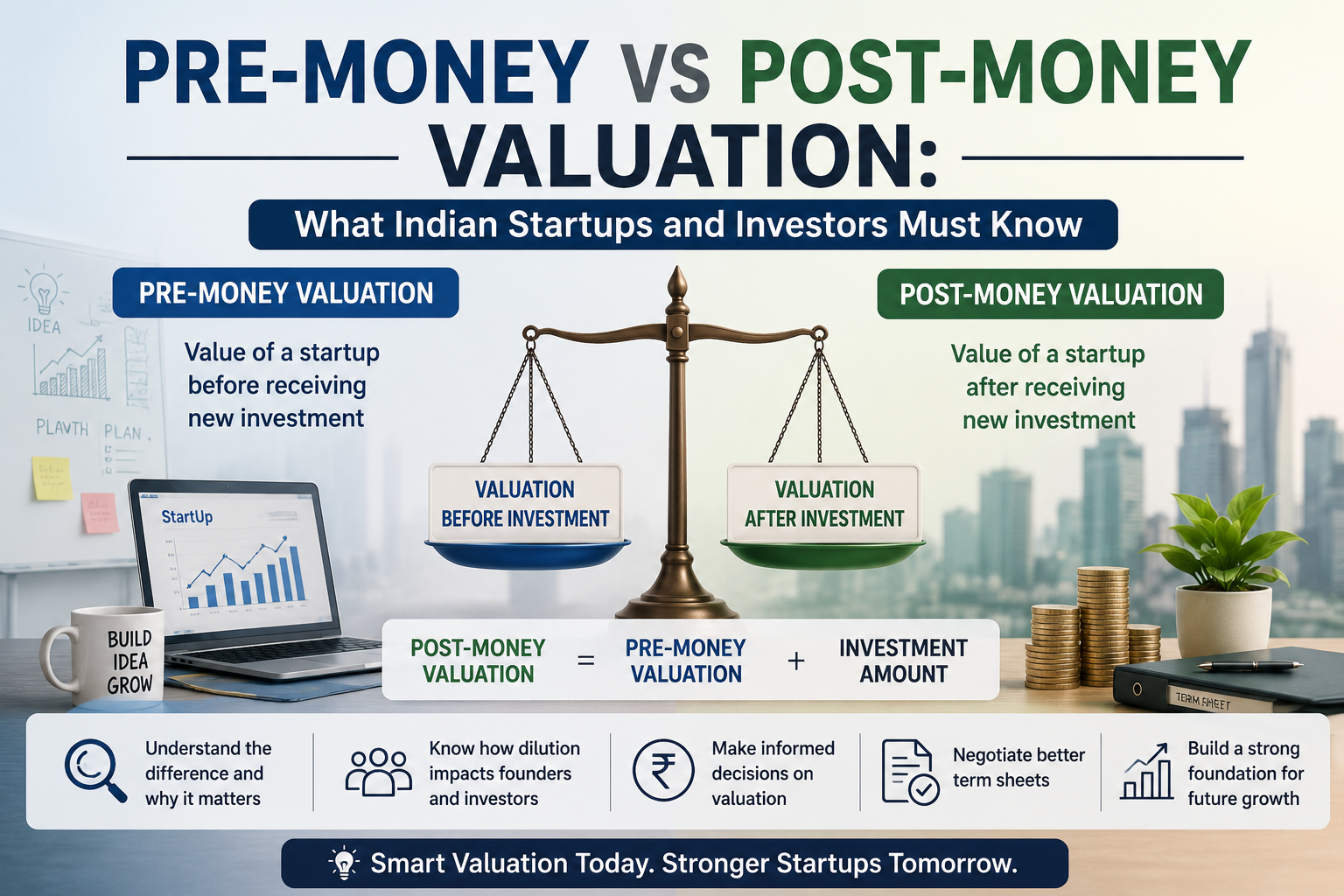
Two concepts sit at the centre of every investment negotiation: pre-money valuation and post-money valuation.
Pre-Money Valuation
Pre-money valuation is the value of a company before new investment capital is added. It represents what the business is worth immediately before a funding round closes.
Example:
A startup is valued at Rs 8 crore before receiving any new investment. An investor agrees to contribute Rs 2 crore.
• Pre-money valuation = Rs 8 crore
• New investment = Rs 2 crore
The pre-money valuation is Rs 8 crore — the company's worth before the funds arrive.
Post-Money Valuation
Post-money valuation is the value of the company after the new investment has been added. The formula is straightforward:
Post-Money Valuation = Pre-Money Valuation + Investment Amount
Example (continued)
Using the figures above:
• Pre-money valuation: Rs 8 crore
• Investment amount: Rs 2 crore
• Post-money valuation: Rs 10 crore
How Ownership Is Calculated
The investor's ownership percentage is calculated against the post-money valuation:
Investor Ownership = Investment Amount / Post-Money Valuation
In the example above: Rs 2 crore / Rs 10 crore = 20%. The investor receives 20% ownership; founders and existing shareholders retain 80%.
Why This Distinction Matters
Founder dilution
Every funding round dilutes existing ownership. A founder who misunderstands post-money calculations may unintentionally give away more equity than anticipated, with cascading effects on voting control, future fundraising, and long-term incentives.
ESOP pool sizing
Employee Stock Option Plans are typically carved out before a funding round (i.e., included in the pre-money valuation), further diluting founders. Businesses planning ESOP pools must model the full cap table impact - pre-investment, ESOP carve-out, and post-investment - before finalising terms.
SAFE and convertible notes
Simple Agreements for Future Equity (SAFEs) and convertible notes add complexity to valuation calculations because they convert at a future priced round, often with valuation caps and discount rates. Founders should model multiple conversion scenarios before accepting these instruments.
Regulatory and Compliance Considerations for Indian Startups
In India, fundraising transactions carry regulatory obligations that founders must not overlook:
Foreign investment - FEMA compliance
Where investors are foreign nationals or foreign entities, the investment must comply with the Foreign Exchange Management Act, 1999 (FEMA) and the Foreign Direct Investment (FDI) Policy administered by the Reserve Bank of India. Pricing guidelines under FEMA require that shares issued to foreign investors are not priced below the fair value determined by a registered valuer using a recognised valuation methodology (such as DCF). Violations can attract penalties under FEMA.
Valuation reports
For companies issuing shares to foreign investors, a valuation certificate from a SEBI-registered merchant banker or chartered accountant may be required. Domestic rounds involving convertible instruments may require separate tax-related valuation under the Income Tax Act, 1961 (especially relevant for Section 56(2)(viib), commonly called the 'angel tax' provision, though the exemption landscape has evolved).
Shareholder and board approvals
Share issuances require proper board and shareholder resolutions, updated share certificates, and ROC filings including Form PAS-3 (return of allotment) within the prescribed timeline under the Companies Act, 2013.
Common Mistakes in Valuation Discussions
Confusing pre-money with post-money
This is the most costly misunderstanding in startup fundraising. If a founder believes an investor's Rs 20 crore valuation is pre-money while the investor means post-money, the equity split will be materially different — potentially costing founders several percentage points of ownership.
Ignoring future dilution
Founders often focus only on the current round. Future rounds, ESOP expansions, and convertible instrument conversions can substantially dilute ownership over time. Model your cap table through at least two or three future hypothetical rounds.
Down-round risk from over-valuation
An unrealistically high early-stage valuation creates pressure to justify growth expectations. If subsequent performance falls short, the company may face a down round - raising capital at a lower valuation — which can trigger anti-dilution rights held by earlier investors, further diluting founders and employees.
Best Practices for Startups During Fundraising
• Maintain a current, accurate cap table at all times
• Seek professional advisory support covering legal, financial, and tax implications
• Ensure all agreements, resolutions, valuation reports, and ROC filings are properly executed and filed on time
• Model multiple valuation scenarios - including SAFE conversions and ESOP dilution - before signing term sheets
• For foreign investment, obtain FEMA compliance sign-off before or concurrently with closing
Conclusion
The difference between pre-money and post-money valuation is foundational to every startup fundraising conversation. While the arithmetic is simple, the strategic, legal, and regulatory implications are significant. Understanding how ownership is calculated, how FEMA pricing guidelines apply, and how future dilution accumulates helps founders and investors negotiate from an informed position.
At KP Regtech, we assist startups, fintech companies, and regulated businesses with compliance advisory, governance support, regulatory documentation, and transaction-readiness solutions.