
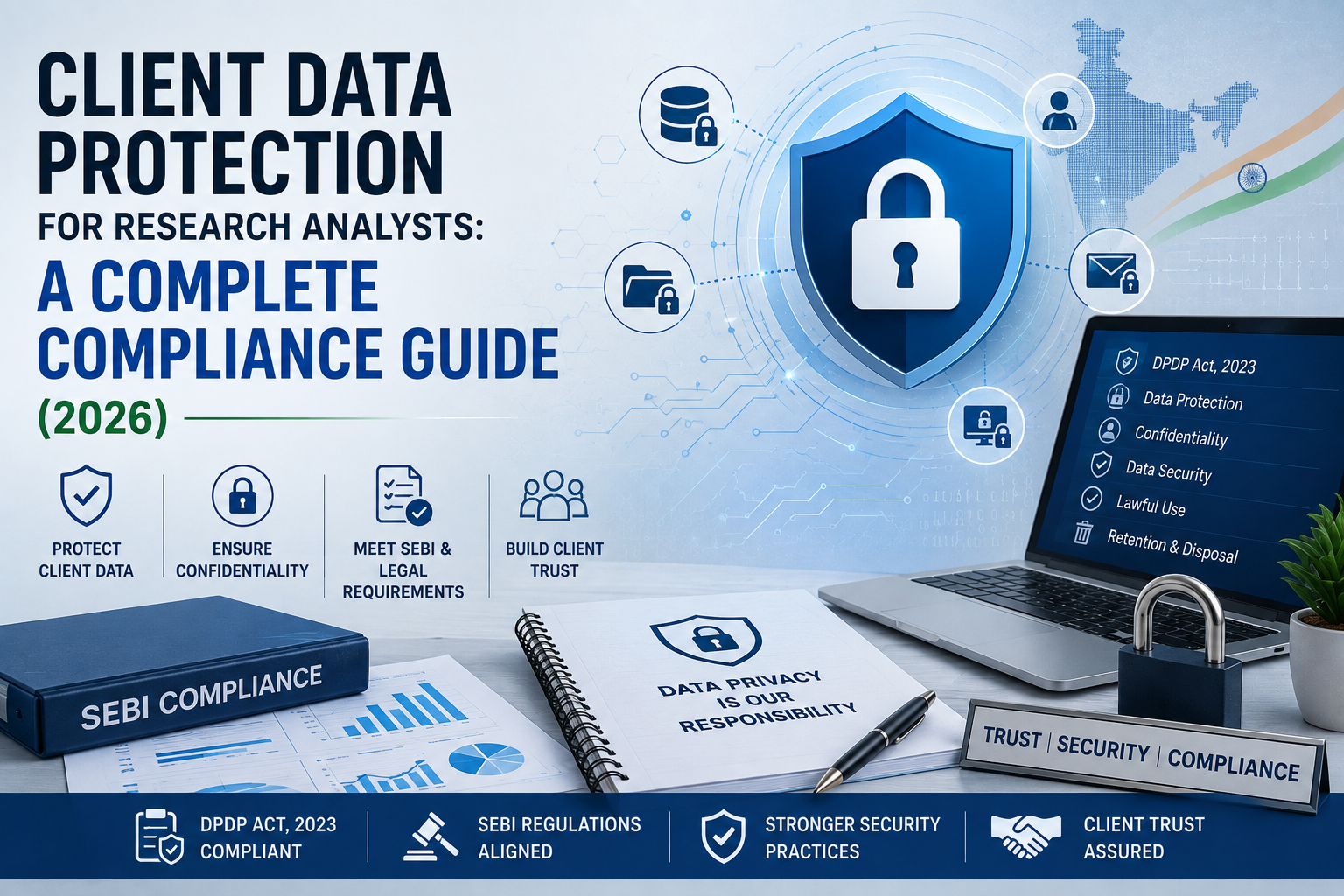
In today's digital-first financial ecosystem, Research Analysts (RAs) routinely collect, store, process, and transmit significant volumes of confidential investor information. Whether onboarding clients, delivering research reports, maintaining subscription databases, or communicating investment recommendations, every interaction involves handling personal and financial data that investors expect will remain secure.
Protecting client information is no longer limited to maintaining confidentiality. It now requires Research Analysts to establish structured governance, implement robust cybersecurity measures, comply with India's Digital Personal Data Protection (DPDP) Act, 2023, and meet the ethical standards prescribed under the SEBI (Research Analysts) Regulations, 2014.
A single data breach can expose sensitive investor information, interrupt business operations, trigger regulatory scrutiny, and significantly damage a firm's credibility. As cyber threats continue to evolve, client data protection has become an essential component of regulatory compliance rather than merely an IT function.
This guide explains how Research Analysts should approach client data protection and the practical steps that can help strengthen compliance while building long-term investor trust.
Why Client Data Protection Matters
Every Research Analyst develops a relationship of trust with clients. Investors share sensitive information because they believe it will be used only for legitimate advisory and research purposes and will be protected from unauthorised access.
The information maintained by Research Analysts often extends far beyond basic contact details. Firms may process identity documents, PAN and Aadhaar information (where collected lawfully), financial profiles, income details, investment objectives, risk tolerance assessments, communication records, payment information, and research subscription history.
If this information is compromised, clients may face financial fraud, identity theft, phishing attacks, or misuse of confidential financial information. For the Research Analyst, such incidents may result in regulatory investigations, legal exposure, reputational damage, and loss of client confidence.
Protecting client data is therefore fundamental to both investor protection and sustainable business growth.
Regulatory Framework Governing Client Data
Client data protection for Research Analysts is influenced by multiple legal and regulatory frameworks.
The SEBI (Research Analysts) Regulations, 2014 require Research Analysts to maintain high standards of integrity, confidentiality, and professional conduct while providing research services. Confidential client information should never be misused or disclosed without appropriate authority.
The Digital Personal Data Protection Act, 2023 further establishes obligations relating to the collection, processing, storage, security, and lawful use of digital personal data. Since Research Analysts routinely determine how client information is processed for providing regulated services, they are generally expected to comply with the applicable provisions of the DPDP framework.
In addition, cybersecurity expectations, contractual obligations, and general principles of information security all contribute to an organisation's responsibility to safeguard client information.
Understanding the Types of Client Data
Research Analysts often underestimate the quantity and sensitivity of information maintained during ordinary business operations.
Client information may include identity and KYC documents, residential and communication details, financial statements, bank account information, investment experience, portfolio discussions, transaction history, invoices, payment records, signed agreements, email correspondence, research preferences, complaint records, and internal notes relating to client interactions.
Much of this information is commercially sensitive and financially valuable. Accordingly, organisations should understand what data they collect, why it is collected, where it is stored, who has access to it, and how long it should be retained.
A clear understanding of the firm's data inventory forms the foundation of an effective data protection programme.
Confidentiality Obligations
Confidentiality is one of the core ethical responsibilities of every Research Analyst.
Client information should be used exclusively for legitimate professional purposes and should never be disclosed to unauthorised persons or used for personal benefit. Employees and associated persons should clearly understand that confidentiality obligations continue even after employment or contractual relationships end.
Research firms should also ensure that discussions relating to client portfolios, investment objectives, and financial information take place only through secure and authorised communication channels.
Maintaining confidentiality demonstrates professionalism and reinforces investor confidence in the firm's governance standards.
Implementing Strong Data Governance
Effective client data protection begins with proper governance rather than technology alone.
Every Research Analyst should establish documented internal policies explaining how client information is collected, processed, stored, accessed, shared, retained, and securely deleted when no longer required.
These policies should clearly assign responsibilities to employees and define approval mechanisms for handling sensitive information.
Senior management should periodically review these policies to ensure they remain aligned with regulatory developments, technological changes, and evolving business operations.
Strong governance enables organisations to demonstrate accountability during compliance audits and regulatory inspections.
Cybersecurity as a Critical Safeguard
Client information cannot remain protected without appropriate cybersecurity controls.
Research Analysts increasingly rely on cloud platforms, email systems, CRM software, investor portals, mobile devices, and digital communication tools. Each of these systems represents a potential entry point for cybercriminals if not properly secured.
Firms should adopt layered security measures that include strong authentication mechanisms, encrypted storage, secure backups, endpoint protection, software updates, network monitoring, and controlled user access.
Cybersecurity should not be viewed as a one-time implementation but as an ongoing process of identifying, monitoring, and responding to emerging threats.
Securing Client Communications
Research Analysts communicate with investors through emails, messaging platforms, video conferencing applications, websites, and client portals. These communication channels frequently contain confidential information that requires appropriate protection.
Sensitive documents should be shared only through secure channels, and access to client communications should be limited to authorised personnel. Firms should also maintain appropriate records of communications where required under applicable regulations while ensuring that these records remain protected against unauthorised access.
Care should be taken to verify recipient details before sharing confidential reports or financial information electronically.
Third-Party Service Providers
Many Research Analysts rely on external vendors for website hosting, cloud storage, CRM platforms, accounting software, payment gateways, and communication systems.
Although these services may be outsourced, responsibility for protecting client data cannot be outsourced entirely. Research Analysts should conduct appropriate due diligence before engaging technology vendors and periodically review whether external service providers continue to maintain adequate security standards.
Vendor contracts should clearly define confidentiality obligations, security expectations, and responsibilities relating to client information.
Strong vendor governance significantly reduces operational and regulatory risk.
Employee Awareness and Internal Controls
Technology alone cannot prevent data breaches if employees are not adequately trained.
Many security incidents occur because of phishing emails, weak passwords, accidental disclosures, improper document sharing, or failure to recognise suspicious activity.
Research Analysts should establish periodic awareness programmes covering confidentiality obligations, phishing prevention, password management, secure remote working practices, and incident reporting procedures.
Creating a culture in which employees recognise their responsibility for protecting client information is one of the most effective long-term safeguards.
Preparing for Data Breaches
Despite implementing robust controls, no organisation is completely immune from cyber incidents. Accordingly, every Research Analyst should prepare for the possibility of a data breach before one occurs.
An incident response framework should establish procedures for identifying, investigating, containing, documenting, and recovering from security incidents. Responsibilities should be clearly assigned so that employees understand whom to notify and how to respond when suspicious activity is detected.
Prompt response not only limits operational disruption but also demonstrates organisational preparedness during regulatory review.
Common Data Protection Mistakes
Many client data protection failures arise from everyday operational practices rather than sophisticated cyberattacks.
Common issues include storing confidential documents on personal devices, sharing client information through unsecured messaging applications, failing to remove access for former employees, using weak passwords, neglecting software updates, maintaining outdated privacy policies, and granting excessive access rights to internal users.
Regular internal reviews help identify and correct these weaknesses before they result in significant compliance or cybersecurity incidents.
Building Investor Trust Through Responsible Data Protection
Client data protection should be viewed as an investment in long-term credibility rather than merely a regulatory requirement.
Investors are increasingly aware of privacy risks and prefer to engage with firms that demonstrate strong governance and responsible handling of personal information. Organisations that adopt transparent privacy practices, implement effective cybersecurity controls, and maintain documented compliance processes are more likely to earn investor confidence and strengthen their professional reputation.
As digital financial services continue to expand, robust client data protection will become an increasingly important competitive advantage for Research Analysts.
How KP RegTech Supports Research Analysts
KP RegTech assists Research Analysts in strengthening their data governance and regulatory compliance through practical, business-oriented solutions. Our services include DPDP compliance advisory, website compliance reviews, privacy policy drafting, cybersecurity governance support, annual SEBI compliance audits, compliance framework development, inspection readiness, regulatory documentation, and ongoing compliance retainership.
By combining legal, compliance, and technology expertise, we help Research Analysts establish systems that protect client information while meeting evolving regulatory expectations.
Frequently Asked Questions
Does the DPDP Act apply to Research Analysts?
Where Research Analysts collect and process digital personal data while providing regulated services, they should comply with the applicable provisions of the Digital Personal Data Protection Act, 2023.
Why is client confidentiality important?
Maintaining confidentiality protects investors, preserves trust, supports ethical business practices, and aligns with the professional standards expected under the SEBI (Research Analysts) Regulations.
Can small Research Analyst firms be targeted by cybercriminals?
Yes. Smaller firms are frequently targeted because attackers often assume they have weaker cybersecurity controls than larger financial institutions.
Should Research Analysts review their privacy policies regularly?
Yes. Privacy documentation should be reviewed periodically, particularly after regulatory changes, technology upgrades, or significant changes in business operations.
Is cybersecurity only an IT responsibility?
No. Protecting client information requires involvement from senior management, compliance teams, employees, and technology professionals. Cybersecurity is an organisation-wide governance responsibility.
Conclusion
For Research Analysts, client data protection is no longer limited to maintaining confidentiality—it has become a critical component of regulatory compliance, cybersecurity, and investor protection. As digital engagement continues to increase and privacy expectations evolve under the DPDP Act, firms must adopt structured governance, strengthen cybersecurity controls, and establish clear internal policies for handling personal information. Research Analysts that invest in robust data protection frameworks today will not only reduce regulatory and operational risks but also reinforce investor confidence and build a stronger, more trusted practice.