
What Is a Power of Attorney?
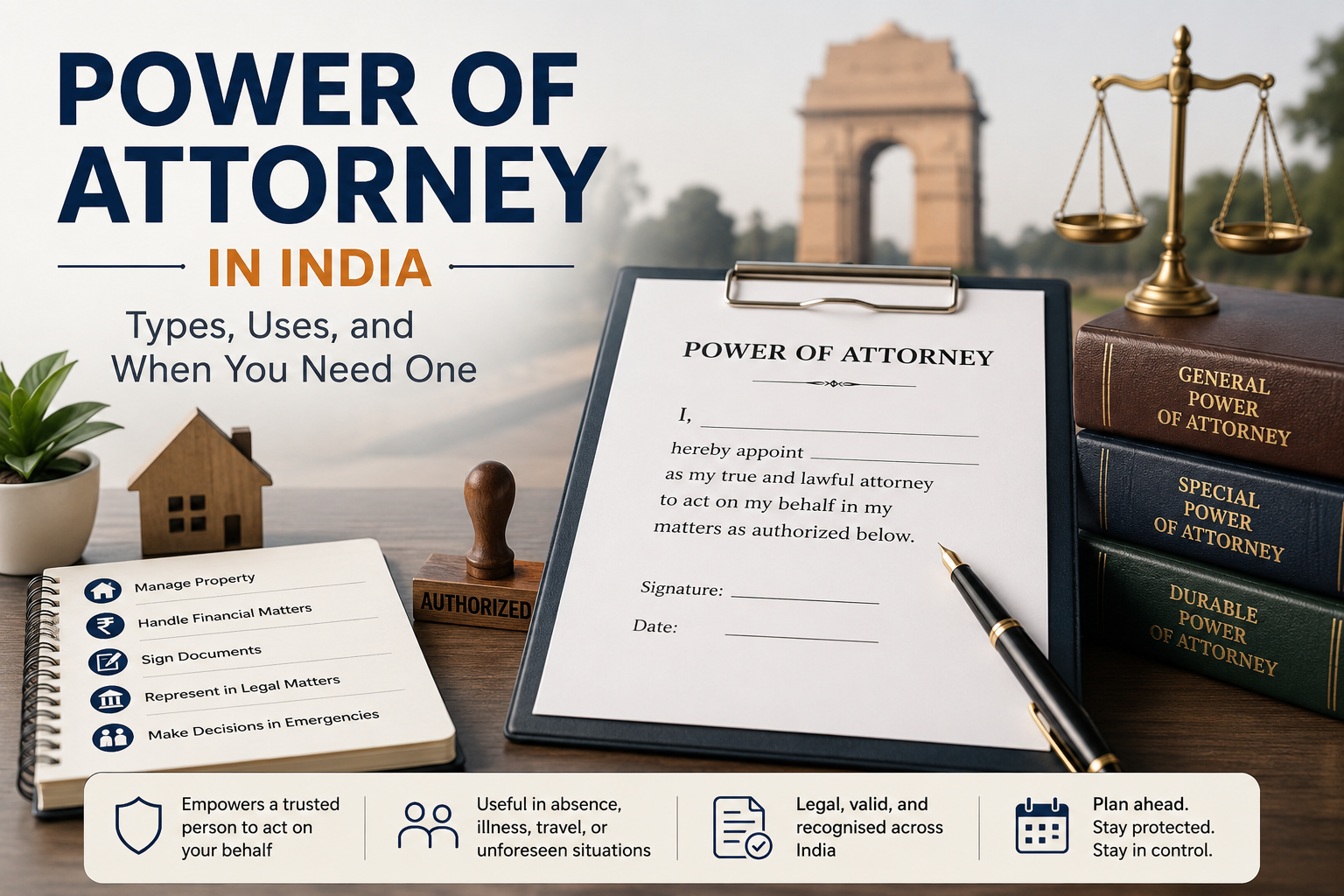
A Power of Attorney (POA) is a legal document through which one person — the Principal — formally authorises another person, known as the Agent or Attorney-in-Fact, to act on their behalf in specified legal, financial, or personal matters. In India, POAs are primarily governed by the Powers of Attorney Act, 1882, and must comply with applicable registration and stamp duty requirements under the Registration Act, 1908 and relevant state stamp laws.
A Power of Attorney can be used for:
• Financial transactions and banking operations
• Property purchase, sale, or management
• Legal representation before courts or authorities
• Business and corporate compliance matters
• Medical or personal decision-making (advisory use — see note below)
Why a Power of Attorney Is Important
A properly drafted POA ensures that important decisions and transactions continue smoothly even when the Principal is unavailable, travelling abroad, incapacitated, or unable to act personally.
Business Continuity
Companies frequently authorise directors, employees, or compliance professionals to execute documents and manage operational matters on their behalf.
Convenience for NRIs and Remote Professionals
Non-resident Indians (NRIs) are among the most common users of POAs in India, particularly for property transactions and financial management. Indian courts have extensively dealt with NRI POA disputes, making proper drafting and registration especially important in this context.
Faster Decision-Making
A POA avoids delays in banking, property registration, litigation, and regulatory filings by allowing an authorised agent to act without the Principal being physically present.
Types of Power of Attorney in India
General Power of Attorney (GPA)
A General Power of Attorney grants broad authority to the Agent, which may include operating bank accounts, managing business operations, signing contracts, handling property matters, and representing the Principal before government authorities. Because of its wide scope, a GPA should be carefully drafted to avoid misuse. Indian courts have increasingly scrutinised GPAs used in property transactions; the Supreme Court of India in Suraj Lamp & Industries Pvt. Ltd. v. State of Haryana (2012) significantly restricted the use of GPAs as substitutes for registered sale deeds.
Special or Specific Power of Attorney
A Special Power of Attorney is restricted to a single act or transaction — for example, selling one specific property, appearing before a registrar, or signing a particular agreement. Once the specified task is completed, the authority ends. This is the most commonly recommended form for reducing risk and clearly defining responsibilities.
Durable Power of Attorney
In Indian practice, the term 'Durable Power of Attorney' broadly refers to a POA that is expressly drafted to survive the mental or physical incapacity of the Principal. Unlike jurisdictions such as the United States, India does not have a dedicated statute for durable POAs; the concept is implemented through careful drafting that explicitly states the POA shall remain operative notwithstanding subsequent incapacity. Legal counsel should be involved in drafting such documents.
Note: 'Medical Power of Attorney' as a distinct instrument is not currently codified under Indian statute law. In practice, healthcare directives and medical decision-making authority are implemented through carefully worded general or special POAs, often alongside advance medical directives. Consult a qualified legal professional for advice specific to your situation.
Limited Power of Attorney
A Limited Power of Attorney grants authority for a specific duration or purpose — for example, authorising someone to complete a financial transaction while you are travelling, or to handle compliance filings for a defined period.
Registration and Stamp Duty Requirements
Whether a POA must be registered depends on its purpose. Under the Registration Act, 1908:
• POAs authorising the Agent to sell immovable property must be executed on stamp paper and are generally required to be registered.
• POAs executed outside India by NRIs must be notarised and apostilled (or consularised), then adjudicated for stamp duty upon arrival in India before use.
• State-specific stamp duty rates vary — confirm applicable rates in the relevant state before execution.
Failure to comply with registration and stamp duty requirements may render the POA inadmissible as evidence or legally unenforceable.
Frequently Asked Questions
Can a Power of Attorney be revoked?
Yes. A POA can generally be revoked by the Principal at any time, provided the Principal has legal capacity, unless it is expressed as irrevocable and coupled with an interest. Revocation should be in writing and communicated to the Agent and relevant third parties.
Does a POA remain valid after the Principal's death?
No. A POA automatically terminates upon the death of the Principal. Any acts performed by the Agent after the Principal's death without knowledge of the death may have limited legal effect depending on the circumstances.
Can an NRI execute a POA abroad?
Yes. An NRI can execute a POA in their country of residence, have it notarised and apostilled, and then use it in India after payment of applicable stamp duty.
Risks of an Improperly Drafted Power of Attorney
Poorly drafted POAs are a common source of property fraud and financial disputes in India. Key risks include:
• Excessive or unclear authority enabling misuse by the Agent
• Failure to register when registration is legally required
• Improper stamp duty leading to inadmissibility
• Ambiguous scope creating disputes between parties
• POAs not updated after changes in Principal's circumstances
Best Practices Before Executing a Power of Attorney
Choose a trustworthy Agent
Appoint someone with the capability, integrity, and proximity to carry out the intended tasks responsibly.
Define powers with precision
Avoid vague language. Clearly specify every action the Agent is authorised to perform, including any financial limits.
Use Special POAs where possible
Limiting authority to a specific transaction reduces misuse risk.
Ensure proper execution and registration
Follow stamp duty and registration requirements applicable in the relevant state. For property-related matters, registration is strongly advisable even where not strictly mandatory.
Review periodically
Revoke and replace POAs that are outdated or no longer reflect your current circumstances.
Conclusion
A Power of Attorney is a powerful legal instrument that enables Principals to delegate authority efficiently and maintain continuity in their personal, financial, and business affairs. Understanding the types of POA available in India, the applicable legal framework under the Powers of Attorney Act 1882 and Registration Act 1908, and the risks of improper execution is essential for reducing legal and operational exposure.
At KP Regtech, we assist businesses and professionals with compliance advisory, documentation support, governance frameworks, and regulatory risk management solutions tailored to modern business needs.