
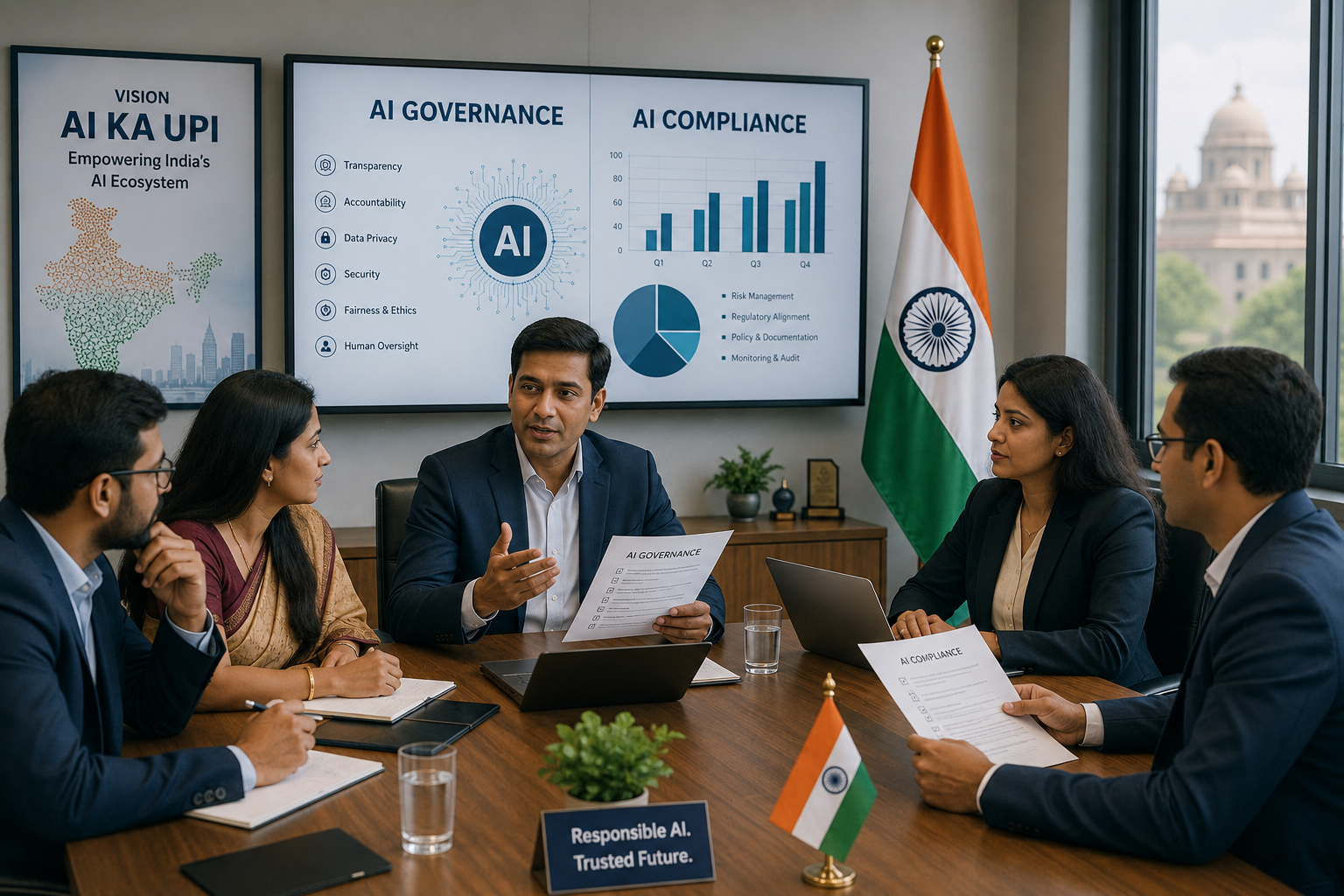
India transformed digital payments through UPI. Now, a similar ambition is being floated for Artificial Intelligence - often described in industry and media commentary as India's "AI Ka UPI" moment: affordable compute infrastructure, indigenous datasets and models, and open, API-accessible innovation platforms.
This article looks at what's actually behind that framing, the regulatory landscape as it stands in 2026, and what fintechs and SEBI-regulated entities should be preparing for.
What Is "AI Ka UPI," Really?
It's worth being precise here: "AI Ka UPI" (also referred to as the "UPI of AI") is not an official government scheme or a formally named mission. It's a phrase used by industry leaders, technologists, and commentators to describe an ambition - building AI infrastructure with the same accessibility, scale, and interoperability that UPI brought to payments.
That ambition does map onto real, ongoing government initiatives, including:
• The India AI Mission, a large public outlay (reported at roughly ₹10,000+ crore) directed at compute capacity, indigenous model development, and startup support
• AI Kosh, a government-backed platform intended to host thousands of datasets for AI development
• The AI Governance Guidelines released in November 2025, which set out a national "AI for All" framing built on India's digital public infrastructure (DPI) experience with Aadhaar and UPI
• The India AI Impact Summit and related government messaging around AI sovereignty, inclusivity, and innovation
So while "AI Ka UPI" isn't itself a law, scheme, or platform you can point to, it's a useful shorthand for a real and active policy direction - one that regulated entities should watch, because infrastructure and access decisions made now will shape compliance expectations later.
Why It Matters for Financial Services
AI is already reshaping India's financial ecosystem. Investment Advisers, Research Analysts, NBFCs, fintech platforms, and banks increasingly rely on AI for:
• Customer onboarding and KYC support
• Fraud detection
• Portfolio analytics and research automation
• Risk profiling
• AI-assisted customer support
• Regulatory monitoring
Cheaper, more accessible AI infrastructure could let even small and mid-sized regulated entities adopt tools that were previously out of reach - a meaningful shift for IAs and RAs operating on thin compliance budgets.
The Regulatory Landscape Is Evolving - But Existing Law Already Applies
India does not yet have a single, dedicated AI law covering all sectors. However, that does not mean AI use is unregulated. Organisations deploying AI must still comply with existing frameworks depending on their activity, including:
• The Digital Personal Data Protection Act, 2023 (DPDP Act)
• The Information Technology Act, 2000, and its rules
• SEBI regulations governing Investment Advisers, Research Analysts, Portfolio Managers, and other intermediaries - including recent SEBI norms requiring disclosure of AI use in research reports and advisory processes
• RBI guidelines applicable to regulated financial entities
• Sector-specific cybersecurity and outsourcing requirements
• The November 2025 AI Governance Guidelines, which - while not binding law - signal the government's intended direction on risk-based AI governance, and are a reasonable indicator of where sector regulators may head next
For financial intermediaries, adopting AI does not reduce regulatory obligations. Firms remain fully responsible for ensuring AI-assisted decisions comply with applicable law - the technology doesn't absorb the liability.
Opportunities for Investment Advisers and Fintechs
An increasingly accessible AI ecosystem could help regulated firms:
• Automate parts of compliance monitoring
• Generate research summaries and drafts (subject to review and disclosure)
• Improve document management and audit trails
• Strengthen investor education content
• Flag potential compliance gaps earlier
• Improve cybersecurity monitoring
• Improve overall operational efficiency
That said, AI should support professional judgement, not substitute for it, in any activity where regulatory responsibility sits with the registered entity - advice, research recommendations, and client communication chief among them.
Compliance Risks Firms Should Not Ignore
As AI adoption grows, firms should proactively manage governance risk. Key areas to address:
• Protection of confidential client information used in or generated by AI tools
• Human oversight and sign-off on AI-generated outputs before they reach clients or the public
• Accuracy of AI-assisted investment communications and research
• Transparency with clients regarding where and how AI is used - now an explicit SEBI expectation for research analysts
• Due diligence on third-party AI vendors, including data handling and cybersecurity practices
• Data retention and audit trails sufficient to reconstruct decisions if questioned by a regulator
A documented AI governance framework helps demonstrate responsible use and materially reduces both operational and regulatory risk.
What Should Businesses Do Today?
Rather than waiting for a dedicated AI law, IAs, RAs, and fintechs should start now:
- Map where AI is currently used across the business - including tools staff may have adopted informally.
- Review contracts with AI service providers for data handling, confidentiality, and liability terms.
- Put a written internal AI usage policy in place.
- Train employees on responsible AI use and its limits.
- Run periodic compliance and cybersecurity assessments covering AI tools.
- Ensure AI-generated content - research, marketing, or client communication - is reviewed by a qualified person before publication.
- Maintain documentation and governance records that would hold up in an audit.
Conclusion
India's "AI Ka UPI" framing captures a genuine ambition: making AI infrastructure more accessible, affordable, and locally developed, building on the same DPI playbook that made UPI a success. Whether that ambition is realised at UPI's scale remains to be seen.
For SEBI-regulated entities and fintechs, though, the practical takeaway doesn't depend on how the vision plays out. AI adoption today should be accompanied by sound governance, robust cybersecurity, strong data protection practices, and ongoing compliance with the laws that already apply. Legal accountability for AI-assisted decisions rests with the regulated entity and its management - not the technology.
Frequently Asked Questions
Is "AI Ka UPI" an official government scheme or law?
No. It's an informal term used by industry and media to describe India's ambition to build accessible AI infrastructure, inspired by initiatives like the India AI Mission, AI Kosh, and the November 2025 AI Governance Guidelines. It is not itself a law, scheme, or regulatory framework.
Can Investment Advisers and Research Analysts use AI?
Yes. IAs and RAs may use AI to support research, operations, and administrative functions, provided they maintain human oversight, disclose AI use where required, and continue to meet all applicable SEBI obligations.
Will India introduce AI-specific regulation?
India's approach is evolving through guidelines rather than a single AI statute so far. Firms should track developments - including sector-specific SEBI and RBI guidance - while ensuring compliance with existing data protection, cybersecurity, and financial regulation in the meantime.
Planning to integrate AI into your financial services business?
KP RegTech advises SEBI-regulated entities, fintech companies, and financial institutions on AI governance, regulatory compliance, data protection, and digital risk management. Our team helps businesses adopt AI responsibly while staying aligned with evolving legal and regulatory expectations. Get in touch to build your AI governance framework today.