
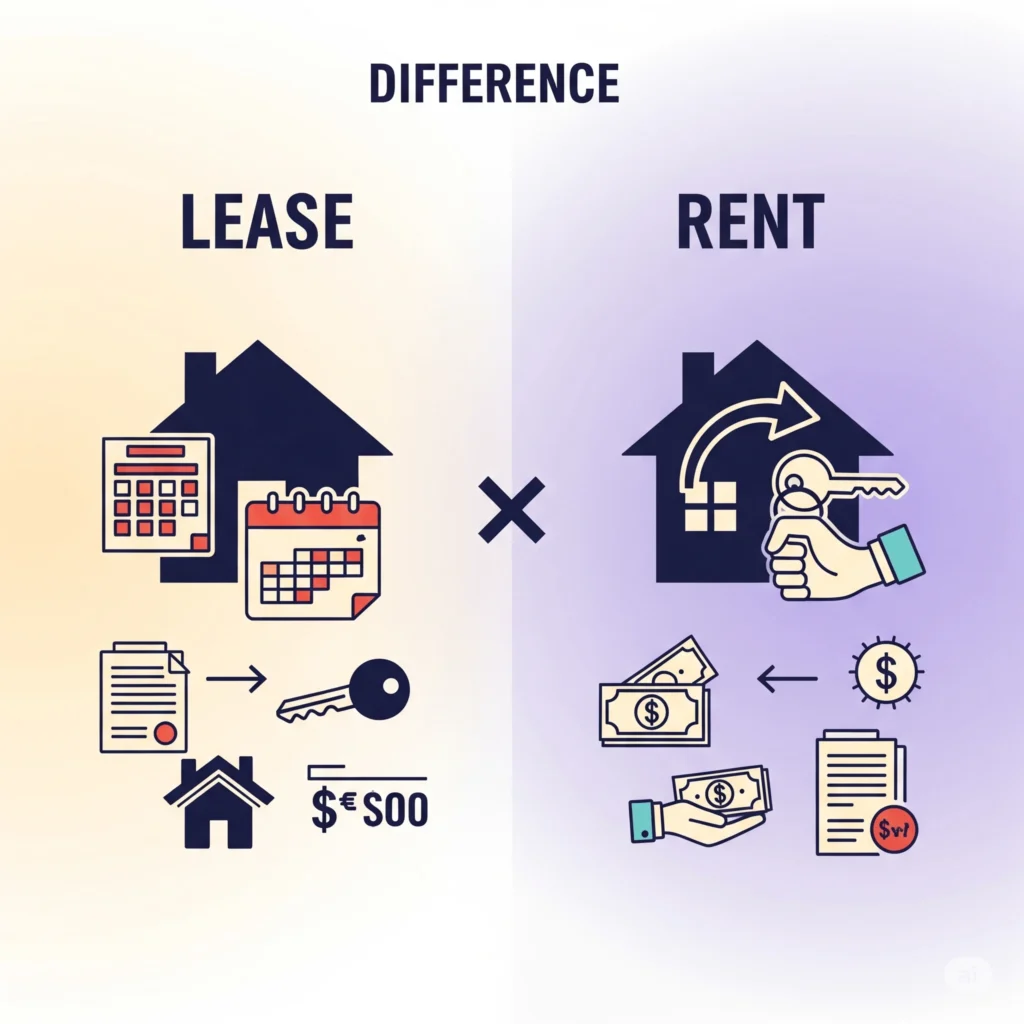
When renting a property in India, the terms rent agreement and lease agreement are often used interchangeably. However, under Indian property law, they are not the same. Each has different legal implications, duration, registration requirements, and rights for both the landlord and tenant.
Understanding the difference between a rent agreement and a lease agreement is important before entering into any rental arrangement.
Legal Basis Under Indian Law
The distinction between rent and lease arises primarily from the Transfer of Property Act, 1882.
A lease is defined as a transfer of the right to enjoy an immovable property for a certain period in exchange for payment of rent or premium.
While the law uses the word “lease” broadly, in practical usage in India, short-term arrangements are called rent agreements and long-term arrangements are called lease agreements.
What is a Rent Agreement?
A rent agreement is a short-term contract between the landlord and tenant that allows the tenant to occupy the property for a limited period in exchange for monthly rent.
In most Indian cities, rent agreements are commonly executed for 11 months.
The main reason for this duration is that agreements longer than one year require mandatory registration under the Registration Act, 1908. By keeping the duration at 11 months, parties often avoid the registration process.
Key Features of a Rent Agreement
• Usually valid for 11 months
• Primarily used for residential properties
• Generally renewed periodically
• Registration is usually not mandatory if the duration is less than one year
• Requires stamp duty as per state laws
Rent agreements are widely used for apartments, houses, and small commercial spaces where the tenant does not intend to occupy the property for a long period.
What is a Lease Agreement?
A lease agreement is a long-term contractual arrangement where the landlord transfers the right to use the property for a specific duration, usually several years.
Lease agreements are commonly used for commercial properties, office spaces, warehouses, and long-term residential arrangements.
Key Features of a Lease Agreement
• Typically valid for more than 12 months
• Must be registered with the Sub-Registrar if the duration exceeds one year
• Often involves a large security deposit or premium
• Provides greater stability and rights to the tenant
• Terms are usually more detailed and comprehensive
Because of the longer duration, lease agreements offer tenants stronger legal protection against arbitrary eviction.
Registration Requirement
Under Section 17 of the Registration Act, 1908, lease agreements for more than one year must be compulsorily registered.
If such agreements are not registered, they may not be admissible as evidence in court, which can weaken the legal position of the parties involved.
Rent agreements for 11 months or less generally do not require mandatory registration, although many parties choose to register them voluntarily for additional legal protection.
Stamp Duty Considerations
Both rent agreements and lease agreements require payment of stamp duty, which varies from state to state.
Stamp duty is typically calculated based on:
• Monthly rent amount
• Security deposit
• Duration of the agreement
Failure to execute the agreement on appropriate stamp paper may affect its legal validity.
Which One Should You Choose?
The choice between a rent agreement and a lease agreement depends on the intended duration and nature of the tenancy.
A rent agreement is suitable when:
• The tenant plans to stay for a short period
• Both parties want flexibility to terminate or renew the arrangement
A lease agreement is preferable when:
• The tenant requires long-term stability
• The property is used for commercial purposes
• Both parties want legally binding long-term terms
Conclusion
Although rent agreements and lease agreements are often confused, they serve different purposes in property transactions. Rent agreements are generally used for short-term residential arrangements, while lease agreements are designed for longer-term occupancy and often involve more formal legal requirements.
Before signing any property agreement, it is important to understand the duration, registration requirements, and legal rights associated with each type of contract. A clear understanding of these differences can help both landlords and tenants avoid future disputes and ensure a smooth rental relationship.